

Morocco Work Visa: Complete 2026 Guide to Working Legally
A Morocco work visa is a long-stay visa issued through a Moroccan embassy or consulate that allows foreign nationals to live and work legally in Morocco. Unlike the tourist or business eVisa, the work visa requires employer sponsorship, a valid work permit from the Moroccan labor authorities, and a signed employment contract. The eVisa system launched in July 2022 does not authorize employment – anyone planning to work in Morocco must apply through the consular visa route.
Morocco’s growing economy, strategic location between Europe and Africa, and expanding sectors like technology, tourism, manufacturing, and renewable energy attract thousands of foreign workers each year. Understanding the work visa process is essential for a smooth transition.
Can You Work in Morocco with an eVisa?
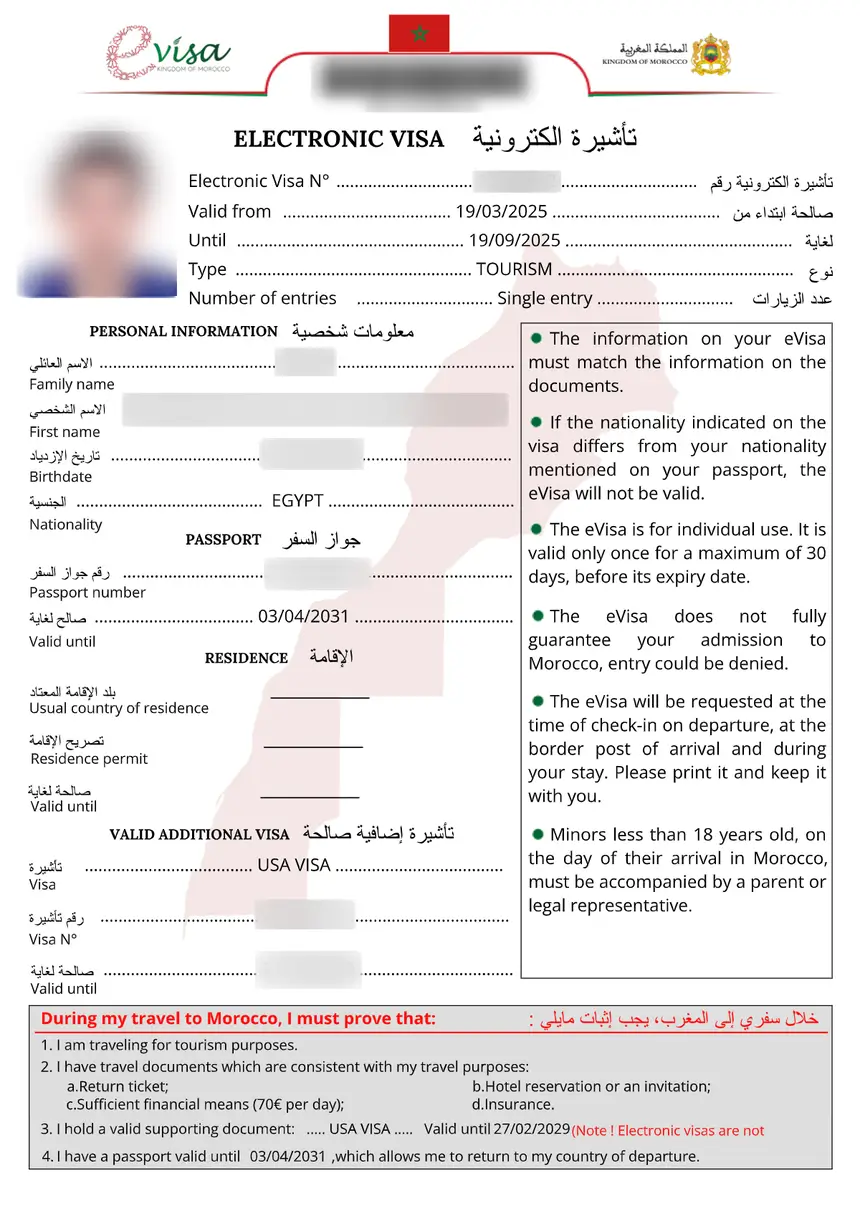
No, you cannot work in Morocco with an eVisa. The Morocco eVisa – whether tourist or business – is strictly for short-term, non-employment purposes. The business eVisa permits attendance at meetings, conferences, and trade events, but explicitly prohibits taking up any form of paid employment.
Key distinctions between the eVisa and work visa:
- eVisa (tourist/business): Maximum 30 days, single-entry, online application, no employment allowed
- Work visa: Long-stay, employer-sponsored, embassy application, full employment rights
If you enter Morocco on an eVisa or visa-free entry (available to citizens of over 65 countries for up to 90 days) and then take up employment, you are violating Moroccan immigration law. Penalties include fines, deportation, and potential re-entry bans.
For a complete overview of all visa options, see our guide to Morocco visa types.
Types of Morocco Work Permits
Morocco issues different categories of work permits depending on the nature of employment. The main types include:
Temporary Work Permit
– Duration: Up to 3 months
– For short-term assignments, seasonal work, or specific projects
– Employer must demonstrate that no qualified Moroccan worker is available
Standard Work Permit
– Duration: 1 year, renewable
– For full-time employment with a Moroccan-registered company
– Requires a signed employment contract and ANAPEC labor market certification
Highly Skilled Worker Permit
– Duration: Up to 3 years
– For specialized professionals in sectors with labor shortages
– Simplified processing for candidates with advanced qualifications
Intra-Company Transfer Permit
– Duration: Up to 2 years
– For employees transferring from a foreign branch to a Moroccan office
– Requires proof of existing employment relationship with the parent company
Each permit type has specific eligibility criteria and documentation requirements. Your employer in Morocco typically handles the initial work permit application on your behalf.
Morocco Work Visa Requirements
To apply for a Morocco work visa, you must provide the following documents:
Personal Documents
– Valid passport with at least 6 months validity remaining and at least 2 blank pages
– Completed visa application form (obtained from the Moroccan consulate)
– Two recent passport-sized photos (35mm x 45mm, light background)
– Police clearance certificate from your country of residence
– Medical certificate proving you are free from contagious diseases
Employment Documents
– Signed employment contract with a Moroccan-registered employer
– Work permit or labor authorization issued by the Moroccan Ministry of Employment
– ANAPEC certification confirming the labor market test was completed
– Employer’s company registration documents (Patente and RC extract)
Financial and Accommodation Documents
– Proof of sufficient financial means (salary stated in employment contract)
– Proof of accommodation in Morocco (rental agreement or employer-provided housing)
– Travel insurance covering the duration of your stay
All documents not in Arabic or French must be officially translated and apostilled or legalized.
How Employers Sponsor a Work Visa in Morocco
The Morocco work visa process is employer-driven. Before a foreign worker can apply for a visa, the Moroccan employer must complete several steps domestically:
Step 1: Labor Market Test (ANAPEC Certification)
The employer must register the job vacancy with ANAPEC (Agence Nationale de Promotion de l’Emploi et des Compétences) – Morocco’s national employment agency. ANAPEC conducts a labor market test to verify that no qualified Moroccan candidate is available for the position. This process typically takes 2 to 4 weeks.
Step 2: Work Permit Application
Once ANAPEC certification is obtained, the employer applies for a work permit through the provincial labor authority (Direction Provinciale de l’Emploi). The application includes the employment contract, ANAPEC certification, and the foreign worker’s qualifications.
Step 3: Ministry Approval
The work permit application is reviewed by the Ministry of Employment and Professional Integration. In some cases, the Ministry of Foreign Affairs also provides pre-approval. Processing can take 4 to 8 weeks.
Step 4: Visa Authorization
Once the work permit is approved, the employer sends the authorization documents to the foreign worker, who then uses these to apply for the work visa at the nearest Moroccan embassy or consulate.
Step-by-Step: How to Apply for a Morocco Work Visa
Follow these steps to apply for your Morocco work visa:
Step 1: Secure a Job Offer
Find employment with a Moroccan-registered company. The employer must be willing to sponsor your work permit and go through the ANAPEC labor market test.
Step 2: Employer Obtains Work Permit
Your employer handles the ANAPEC certification and work permit application in Morocco. This process typically takes 4 to 8 weeks.
Step 3: Gather Your Documents
Collect all required personal documents: passport, photos, police clearance, medical certificate, and any diplomas or professional qualifications (translated and legalized).
Step 4: Submit Visa Application
Visit the Moroccan embassy or consulate in your country with the complete application package. Submit the visa application form along with the work permit authorization from your employer.
Step 5: Attend Interview (if required)
Some consulates may require an interview. Be prepared to discuss your employment details, qualifications, and plans in Morocco.
Step 6: Receive Your Visa
Processing times vary by consulate, but expect 2 to 6 weeks. Once approved, you will receive a long-stay work visa stamped in your passport.
Step 7: Travel to Morocco and Apply for Carte de Séjour
After arriving in Morocco, you must apply for a Carte de Séjour (residence registration card) within 3 months at the local police station.
For general visa application guidance, see our how to apply for Morocco visa guide.
Morocco Work Visa Processing Time and Fees
Processing Time
| Stage | Duration |
|---|---|
| ANAPEC labor market test | 2 to 4 weeks |
| Work permit processing | 4 to 8 weeks |
| Embassy visa processing | 2 to 6 weeks |
| Total end-to-end | 2 to 4 months |
Processing times can be longer during peak periods or if additional documentation is requested. Starting the process well in advance of your planned start date is strongly recommended.
Fees
| Fee Type | Approximate Cost |
|---|---|
| Consular visa fee | 220 MAD (~$22) for single entry |
| Work permit fee | Paid by employer, varies by sector |
| ANAPEC registration | Paid by employer |
| Carte de Séjour | 100 MAD (~$10) annually |
| Document translation and legalization | $50 to $200 depending on country |
The employer typically covers the work permit and ANAPEC fees. The employee is responsible for consular visa fees, document preparation costs, and Carte de Séjour fees.
For a detailed breakdown of all visa-related costs, see our Morocco visa fees page.
Carte de Séjour: Residence Card After Arrival
The Carte de Séjour is a mandatory residence registration card that all foreign workers must obtain within 3 months of arriving in Morocco. Without it, you cannot legally reside or continue working in the country beyond your initial visa validity.
Key details about the Carte de Séjour:
- Where to apply: Local police station (Commissariat) or Bureau des Étrangers
- Validity: 1 year, renewable annually
- Required documents: Passport with work visa, employment contract, proof of accommodation, medical certificate, passport photos, proof of income
- Renewal: Must be renewed at least 1 month before expiration
- Long-term path: After 5 consecutive years of residence, you may apply for a 10-year residence card
The Carte de Séjour also allows you to open a Moroccan bank account, sign rental contracts in your own name, and access certain public services.
Common Reasons for Morocco Work Visa Rejection
Understanding why work visa applications get rejected can help you avoid common pitfalls:
Incomplete Documentation
The most frequent reason for rejection. Missing translations, expired police clearances, or unsigned contracts all lead to delays or denial.
Failed Labor Market Test
If ANAPEC identifies qualified Moroccan candidates for the position, the work permit may be denied. This is more common in general labor categories than in specialized technical roles.
Employer Non-Compliance
If the sponsoring employer is not properly registered, has outstanding tax issues, or has violated labor laws previously, the work permit application may be rejected.
Passport Issues
Passports with less than 6 months validity, insufficient blank pages, or visible damage will result in visa denial.
Criminal Record
A criminal record does not automatically disqualify applicants, but serious offenses – particularly drug-related or violent crimes – are grounds for rejection.
If your application is rejected, you can reapply after addressing the specific issues cited in the rejection notice. There is no mandatory waiting period for reapplication.
Morocco Work Visa vs. Other Long-Stay Options
| Feature | Work Visa | Student Visa | Long-Stay Visa |
|---|---|---|---|
| Purpose | Employment | Study at Moroccan institution | Extended stays (family, retirement) |
| Sponsor required | Yes (employer) | Yes (educational institution) | No |
| Work permitted | Yes | Limited (internships only) | No |
| Duration | Contract-based, up to 1 year | Academic year | Up to 1 year |
| Renewable | Yes | Yes | Yes |
| Carte de Séjour required | Yes | Yes | Yes |
| ANAPEC certification | Required | Not required | Not required |
If you are unsure which visa category applies to your situation, contact the Moroccan consulate in your country. For a comparison of all visa categories, see our Morocco visa types guide.
Sectors with High Demand for Foreign Workers in Morocco
Morocco actively recruits foreign workers in several key sectors where local talent is scarce:
Information Technology
Software developers, data engineers, cybersecurity specialists, and IT project managers are in high demand, particularly in Casablanca and Rabat’s growing tech hubs.
Tourism and Hospitality
Hotel managers, chefs, tourism marketing professionals, and multilingual customer service staff are needed across Morocco’s major tourist destinations including Marrakech, Fes, and Agadir.
Renewable Energy
Morocco is a leader in solar and wind energy in Africa. Engineers and project managers for the Noor solar complex and wind farm projects are regularly recruited internationally.
Education
English language teachers, university lecturers, and international school staff are in demand, particularly in Casablanca, Rabat, and Tangier.
Manufacturing and Automotive
Morocco’s automotive sector (Renault, Stellantis factories in Tangier and Kenitra) recruits engineers, quality control specialists, and supply chain managers.
Construction and Engineering
Large infrastructure projects related to the 2030 FIFA World Cup co-hosted by Morocco require civil engineers, architects, and project managers.
FAQs About Morocco Work Visa
Can I convert my tourist visa to a work visa while in Morocco?
No, you cannot convert a tourist visa or eVisa into a work visa while inside Morocco. The work visa must be obtained from a Moroccan embassy or consulate in your home country before traveling. Your employer must first secure the work permit through ANAPEC, and you must then apply for the visa abroad. Entering Morocco on a tourist visa with the intention of working is a violation of immigration law.
How long does it take to get a Morocco work visa?
The complete process takes approximately 2 to 4 months from start to finish. The ANAPEC labor market test takes 2 to 4 weeks, work permit processing takes 4 to 8 weeks, and embassy visa processing takes 2 to 6 weeks. Starting early and ensuring all documents are complete can help avoid delays.
Do I need to speak French or Arabic to work in Morocco?
While not a formal visa requirement, French is the primary business language in Morocco and is essential for most professional roles. Arabic (Darija) is the everyday spoken language. English is increasingly used in tech and international companies, but French proficiency significantly improves your job prospects and daily life integration.
Can my family join me on a Morocco work visa?
Yes, your spouse and dependent children can apply for a family reunification visa after you have held your Carte de Séjour for at least one year. Family members receive their own Carte de Séjour and can live in Morocco, but your spouse would need a separate work permit to take up employment.
What is ANAPEC and why is it important?
ANAPEC (Agence Nationale de Promotion de l’Emploi et des Compétences) is Morocco’s national employment agency. It conducts the mandatory labor market test to confirm that no qualified Moroccan worker is available for the position. Without ANAPEC certification, the work permit cannot be issued. The employer initiates this process, not the employee.
Is there an age limit for Morocco work visas?
There is no official age limit for Morocco work visa applicants. However, the standard retirement age in Morocco is 63 (increasing to 65). Applicants over 60 may face additional scrutiny regarding their ability to perform the job and may need to provide additional medical documentation.
Can I change employers while on a Morocco work visa?
Changing employers requires a new work permit application. Your new employer must go through the ANAPEC labor market test and obtain a fresh work authorization. You cannot simply transfer your existing work permit. During the transition period, your current Carte de Séjour remains valid until its expiration date.
What happens if I overstay my work visa in Morocco?
Overstaying your visa or Carte de Séjour in Morocco is a serious immigration violation. Penalties include fines, detention, deportation, and potential re-entry bans. If you cannot leave Morocco due to circumstances beyond your control, contact your nearest police station to regularize your status and obtain a written exit permit.
Can EU or US citizens work in Morocco without a visa?
No. Citizens of the EU, US, UK, and other visa-exempt countries can enter Morocco without a visa for tourism stays of up to 90 days, but this does not include work authorization. To take up employment, even visa-exempt nationals must obtain a work visa through the consular process. The visa-free entry is strictly for tourism and short business visits.
How much does a Morocco work visa cost in total?
The total cost varies. The consular visa fee is approximately 220 MAD (~$22). Document preparation (translations, legalizations, police clearance) typically costs $50 to $200 depending on your country. The Carte de Séjour costs 100 MAD (~$10) annually. Work permit and ANAPEC fees are paid by the employer. Budget approximately $100 to $300 in total out-of-pocket costs for the employee.