Morocco does not offer a visa on arrival. If your nationality requires a visa, you must obtain one before traveling — either through an e-Visa application online or by visiting a Moroccan embassy or consulate. However, citizens of over 65 countries can visit Morocco visa-free for up to 90 days, meaning most travelers never need a visa at all.
This guide explains everything you need to know about Morocco’s entry requirements, including who qualifies for visa-free entry, how the e-Visa system works, and what to do if you need a consular visa.
Does Morocco Have Visa on Arrival?
No, Morocco does not issue visas on arrival at airports or land borders. Unlike some destinations in Africa and the Middle East, Morocco requires all visa-required travelers to secure their visa before departure.
If you arrive at a Moroccan airport without a valid visa and your nationality is not on the visa-exempt list, you will be denied entry and placed on a return flight. There is no option to purchase or obtain a visa at the immigration counter.
This policy has been in place for decades and applies to all ports of entry, including Casablanca Mohammed V International Airport (CMN), Marrakech Menara Airport (RAK), and all other international airports and seaports.
Who Does Not Need a Visa for Morocco?
Morocco grants visa-free entry to citizens of more than 65 countries. If you hold a passport from one of these nations, you can enter Morocco without any visa or prior authorization for stays of up to 90 days.
The major visa-exempt nationalities include:
| Region | Countries |
|---|---|
| North America | United States, Canada |
| Europe | All 27 EU member states, United Kingdom, Switzerland, Norway, Iceland, Liechtenstein, Monaco, Andorra |
| Asia-Pacific | Japan, South Korea, Australia, New Zealand, Hong Kong, China, Singapore, Malaysia, Indonesia, Philippines |
| South America | Brazil, Argentina, Chile, Colombia, Peru, Venezuela, Mexico |
| Africa | Tunisia, Senegal, Mali, Niger, Gabon, Republic of Congo, Burkina Faso, Cape Verde |
| Middle East | All Gulf Cooperation Council states (Saudi Arabia, UAE, Qatar, Kuwait, Bahrain, Oman), Turkey |
For the full country-by-country breakdown, see our Morocco visa-free countries guide.
Key requirements for visa-free entry:
- Passport valid for at least 6 months from your entry date
- Proof of return or onward travel
- Sufficient funds for your stay
- One blank passport page for the entry stamp
Morocco e-Visa: The Alternative to Visa on Arrival
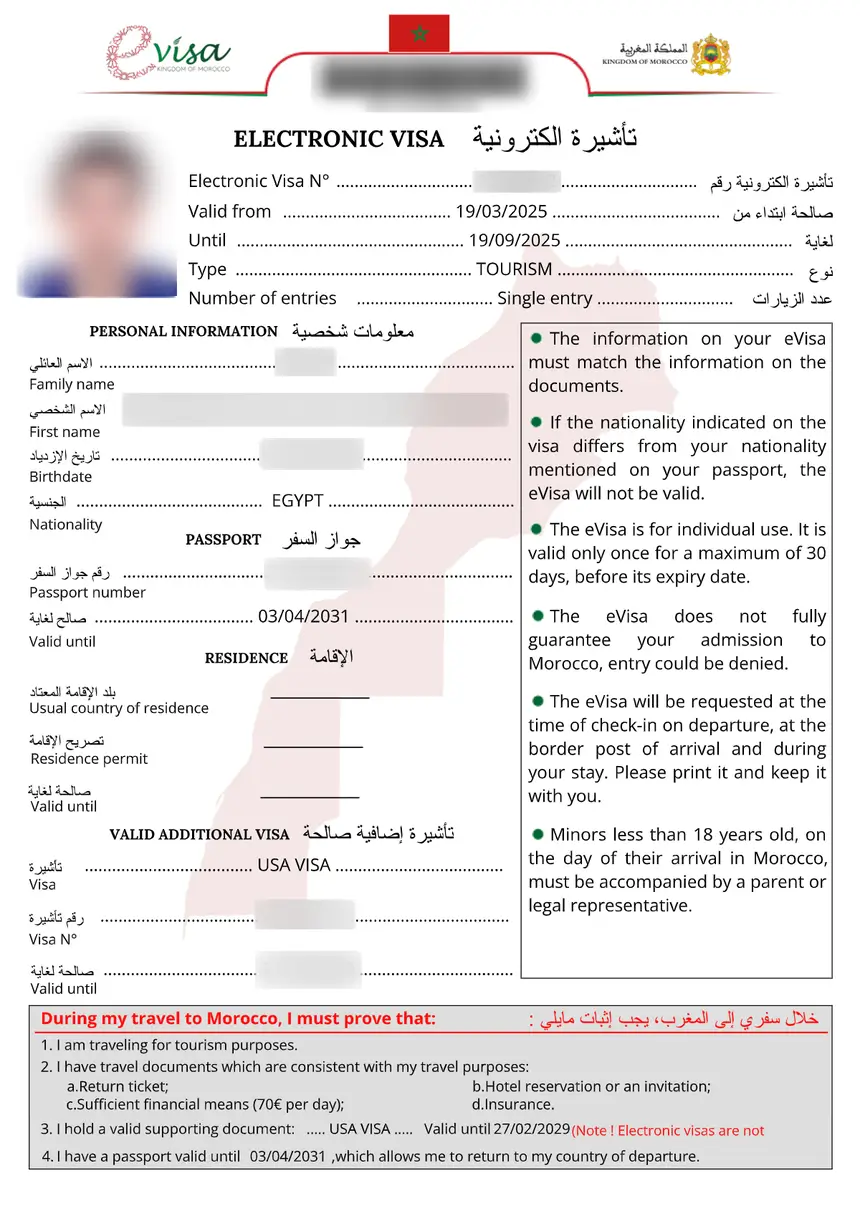
Since Morocco does not offer visa on arrival, the e-Visa system is the closest alternative for travelers who need a visa. Launched on July 10, 2022, the Morocco e-Visa allows eligible nationals to apply entirely online without visiting an embassy.
Who Can Apply for the Morocco e-Visa?
The e-Visa is available to citizens of 10 countries:
- Benin
- Brunei Darussalam
- Cambodia
- Guatemala
- India
- Israel
- Jordan
- Laos
- Thailand
- Vietnam
In addition, citizens of most other visa-required countries can apply for a conditional e-Visa if they hold a valid visa or residence permit from:
- Any Schengen Area country
- United States
- United Kingdom
- Canada
- Australia
- Ireland
- Japan
This conditional e-Visa opens the door for millions of travelers who would otherwise need a consular visa. For example, an Indian passport holder with a valid US visa can apply for the Morocco e-Visa online.
e-Visa Details
| Detail | Information |
|---|---|
| Validity | 180 days from issuance |
| Stay duration | Up to 30 days |
| Entry type | Single entry (convertible to multiple entry in Morocco) |
| Extension | Extendable to 180 days total in-country |
| Processing time | 24-72 hours (official portal) |
| Fee | Approximately MAD 220 (~$22) via official portal |
The official e-Visa portal is acces-maroc.ma. For step-by-step instructions, see our how to apply for Morocco visa guide.
What If You Need a Consular Visa?
If your nationality is not on the visa-exempt list and you do not qualify for the e-Visa, you must apply through a Moroccan embassy or consulate in your country.
Documents Required
- Completed visa application form
- Valid passport (minimum 6 months validity)
- Two recent passport photographs (35mm x 45mm)
- Proof of accommodation in Morocco
- Return flight reservation
- Proof of financial means
- Travel medical insurance
- Visa fee payment
How to Apply at an Embassy
- Contact your nearest Moroccan embassy or consulate to confirm requirements
- Gather all required documents
- Complete the application form
- Book an appointment
- Submit your documents and attend the interview
- Wait for processing (typically 5-15 working days)
- Collect your passport with the visa
For detailed guidance, read our Morocco visa requirements page.
Embassy Visa Fees
| Visa Type | Fee (MAD) | Approximate USD |
|---|---|---|
| Single-entry tourist | 220 | ~$23 |
| Double-entry | 330 | ~$34 |
| Transit visa | 170 | ~$18 |
Morocco AEVM: Electronic Travel Authorization
Nationals of Guinea, Mali, and the Republic of Congo must obtain an Authorization Electronique de Voyage au Maroc (AEVM) before traveling. This is not a visa on arrival — it is an electronic travel authorization that must be approved online before departure.
The AEVM functions similarly to an electronic visa but is a separate category specific to these three nationalities.
Visa on Arrival in Neighboring Countries
If you are traveling across North Africa and wondering about visa-on-arrival policies in the region:
| Country | Visa on Arrival? | e-Visa Available? |
|---|---|---|
| Morocco | No | Yes (eligible nationalities) |
| Tunisia | Yes (for some nationalities) | No |
| Algeria | No | No |
| Mauritania | Yes (available at Nouakchott airport) | Yes |
If you are planning a multi-country North Africa trip, check each country’s requirements separately. Morocco’s lack of visa on arrival means you need to plan ahead.
Frequently Asked Questions
Can US citizens get a visa on arrival in Morocco?
US citizens do not need a visa at all for Morocco. Americans can enter visa-free for stays of up to 90 days with a valid US passport. There is no visa on arrival because none is needed.
Can UK citizens get a visa on arrival in Morocco?
UK citizens are visa-exempt for Morocco and can stay up to 90 days without a visa. A valid British passport is all that is required for entry.
Can Indian citizens get a visa on arrival in Morocco?
No, Indian citizens cannot get a visa on arrival in Morocco. Indian passport holders must apply for either an e-Visa online (if eligible) or a consular visa through a Moroccan embassy. If you hold a valid US, UK, Schengen, Canadian, Australian, or Irish visa, you may qualify for the conditional e-Visa.
Can Pakistani citizens get a visa on arrival in Morocco?
No, Pakistan does not have a visa-on-arrival arrangement with Morocco. Pakistani nationals must apply for a consular visa or, if they hold a qualifying visa (Schengen, US, UK, etc.), apply for the conditional e-Visa online.
Is there any way to get a visa at the airport in Morocco?
No. Morocco strictly requires all visa-required travelers to obtain their visa before arrival. The only exception is visa-exempt nationalities who do not need any visa at all. There is no visa counter, no visa-on-arrival desk, and no emergency visa issuance at any Moroccan airport or port.
What happens if I arrive in Morocco without a visa?
If your nationality requires a visa and you arrive without one, immigration officers will deny entry. You will be held at the airport and placed on the next available return flight at your own expense. Always verify your visa requirements before booking travel.
How long can I stay in Morocco without a visa?
Visa-exempt travelers can stay up to 90 days in Morocco. This applies to citizens of the US, UK, EU, Canada, Australia, Japan, and many other countries. Overstaying the 90-day limit can result in fines and future entry bans.
Can I extend my stay beyond 90 days in Morocco?
If you entered visa-free, you must leave before the 90-day limit. If you entered on an e-Visa (30 days), you can extend it in Morocco up to 180 days total. For longer stays, you need to apply for a residence permit at the local police station.
Summary: Morocco Visa on Arrival Does Not Exist
Morocco’s entry system is straightforward but does not include visa on arrival. Here is what you need to know:
- Visa-exempt travelers (65+ countries): Enter freely with a valid passport for up to 90 days
- e-Visa eligible travelers (10 countries + conditional): Apply online before travel via acces-maroc.ma
- All other nationalities: Apply at a Moroccan embassy or consulate
Plan your Morocco visa well in advance. If you need a visa, the e-Visa process takes 24-72 hours, while embassy applications take 5-15 working days. For the latest information on Morocco visa types and fees, visit our Morocco eVisa complete guide.