Morocco Visa Types: Complete Guide to All Visa Categories
Understanding the different Morocco visa types is essential for anyone planning to visit this North African kingdom. Morocco offers several visa categories, each designed for a specific travel purpose, from short tourist visits to long-term work and study stays. This guide covers every visa type, including the electronic visa (eVisa) system launched in July 2022, to help you choose the right one for your trip.
Overview of Morocco Visa Categories
Morocco operates a structured visa system with multiple categories to accommodate different travel purposes. The country introduced its eVisa system on July 10, 2022, modernizing the application process for eligible nationalities. Citizens of over 65 countries can enter Morocco without a visa, while others must apply for the appropriate visa type based on their travel purpose.
The main Morocco visa types include:
- Tourist eVisa – for leisure travel and sightseeing
- Business eVisa – for professional meetings and conferences
- Short-stay visa – for visits up to 90 days
- Long-stay visa – for stays exceeding 3 months
- Transit visa – for travelers passing through Morocco
- Work visa – for employment in Morocco
- Student visa – for study at Moroccan institutions
- Diplomatic visa – for official passport holders
Each visa type has specific eligibility criteria, duration limits, and application requirements that travelers must meet.
Morocco eVisa Types (Electronic Visa)
The Morocco eVisa is the most convenient option for eligible travelers, allowing a fully online application without visiting an embassy or consulate. There are two main eVisa categories:
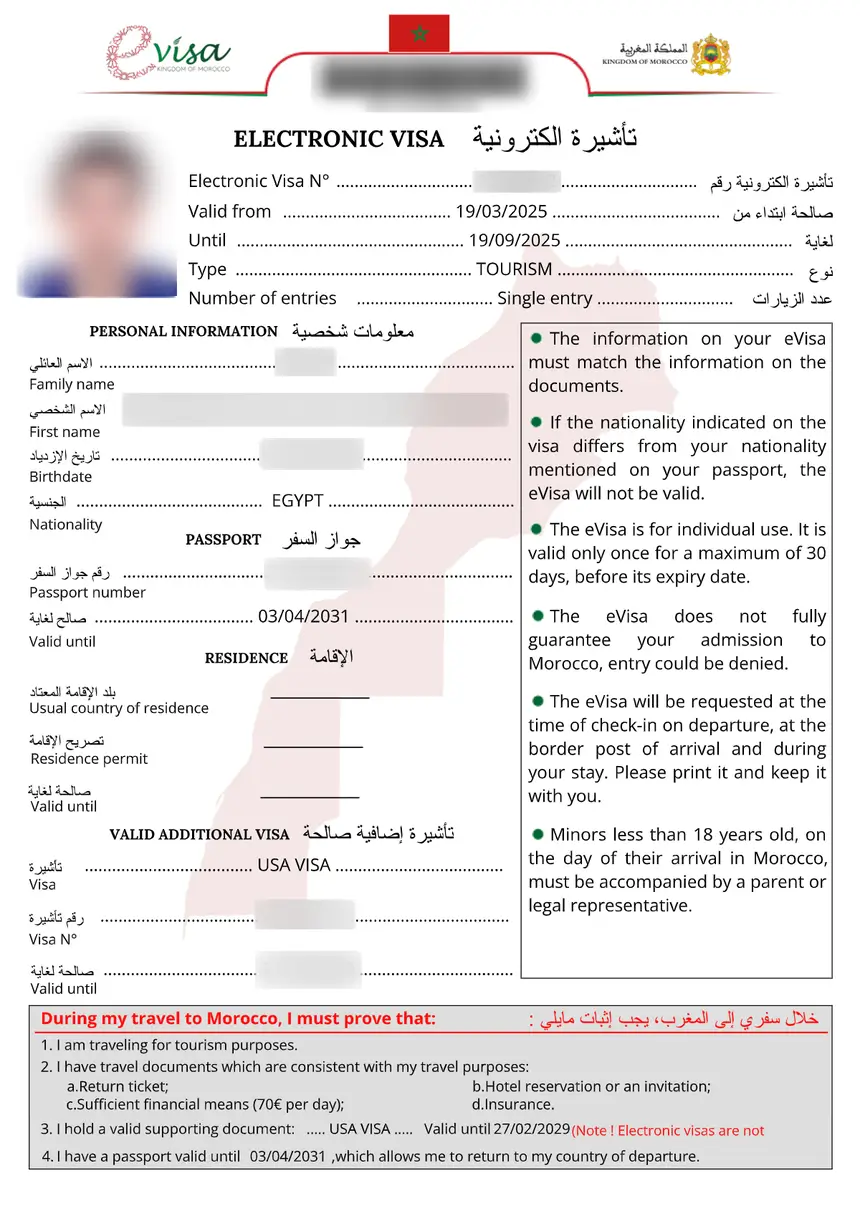
Morocco Tourist eVisa
The tourist eVisa is designed for leisure travel, sightseeing, visiting friends and family, and recreational activities in Morocco. Key specifications include:
- Maximum stay: 30 days
- Validity: 180 days from the date of issue
- Entry type: Single-entry
- Application: Online through the official eVisa portal
Morocco Business eVisa
The business eVisa facilitates entry for professional purposes, including attending business meetings, conferences, trade events, and exploring partnership opportunities. It shares the same validity and duration as the tourist eVisa:
- Maximum stay: 30 days
- Validity: 180 days from the date of issue
- Entry type: Single-entry
- Application: Online through the official eVisa portal
To apply for either eVisa type, travelers need a valid passport with at least 6 months of remaining validity, a recent passport-style photograph, and a confirmed return ticket.
Morocco Short-Stay Visa
The short-stay visa is a traditional embassy-issued visa for travelers who need to enter Morocco for purposes other than immigration. This Morocco visa type allows:
- Duration: Up to 90 days within a 180-day period
- Entry type: Single or multiple-entry
- Purpose: Tourism, business visits, family visits, medical treatment
- Application: At a Moroccan embassy or consulate
The short-stay visa is suitable for travelers from countries not eligible for the eVisa or visa exemption. Applicants must submit their passport, completed application form, passport photos, proof of accommodation, return ticket, and evidence of sufficient funds.
Morocco Long-Stay Visa
The long-stay visa is required for foreigners planning to remain in Morocco for more than 3 months. This visa type has distinct characteristics:
- Duration: Over 3 months, valid for up to 1 year
- Entry type: Multiple-entry
- Each stay: 1 to 90 days per visit
- Special requirement: Issued after consultation with the Ministry of Foreign Affairs and International Cooperation
Holders of a long-stay visa who wish to remain in Morocco beyond 3 months must apply for a registration card from the General Directorate of National Security. This Morocco visa type is commonly used for work assignments, extended study programs, and family reunification.
Morocco Transit Visa
The transit visa is a specialized Morocco visa type for travelers passing through the country en route to a third destination. Its key features are:
- Duration: Up to 72 hours per transit
- Transits allowed: One or two transits
- Purpose: Crossing Moroccan territory to reach another country
- Application: At a Moroccan embassy, consulate, or in exceptional cases at border posts
The transit visa does not permit extended stays or activities beyond transit. Travelers who plan to leave the airport during a layover in Morocco should verify whether they need this visa based on their nationality.
Morocco Work Visa
The work visa is mandatory for foreign nationals seeking employment in Morocco. This Morocco visa type requires:
- A valid work permit issued by a Moroccan employer
- Employment contract with a company registered in Morocco
- Long-term residence authorization
- Application: Through the Moroccan embassy or consulate in the applicants home country
The work visa allows holders to reside and work legally in Morocco for the duration of their employment contract. Employers typically initiate the work permit process on behalf of the foreign employee.
Morocco Student Visa
The student visa is designed for foreign nationals accepted into recognized Moroccan educational institutions. This visa type offers:
- Long-term stay for the duration of academic studies
- Renewable status for multi-year programs
- Requirement: Official acceptance letter from a Moroccan university or institution
- Application: At the Moroccan embassy or consulate
Student visa holders may need to register with local authorities upon arrival and maintain valid enrollment throughout their stay in Morocco.
Morocco Diplomatic and Official Visas
Morocco maintains bilateral agreements with numerous countries that provide visa-free entry or simplified procedures for holders of non-ordinary passports:
- Diplomatic passports – visa-free entry from many partner countries
- Service passports – visa-free or facilitated entry
- Official passports – visa-free or facilitated entry
- Special passports – visa-free or facilitated entry in some cases
Countries with diplomatic visa agreements include Russia, China, Turkey, Brazil, Romania, Portugal, and many others. United Nations laissez-passer holders can enter Morocco without a visa for up to 90 days.
Visa-Exempt Entry and AEVM
Citizens of over 65 countries can enter Morocco without obtaining a visa. However, Morocco has introduced the Electronic Travel Authorization (AEVM) system, which is becoming mandatory for visa-exempt travelers:
- AEVM (ETA): An electronic authorization required before departure
- Who needs it: Nationals of visa-exempt countries (with some exceptions)
- Exceptions: Holders of valid Moroccan residence permits, transit passengers, and spouses of Moroccan citizens
- Purpose: Pre-screening of visa-exempt travelers before arrival
The AEVM is not a visa but a travel authorization that must be obtained online before boarding a flight to Morocco. It represents a shift toward digital border management similar to systems used by the US (ESTA), Canada (eTA), and Australia (ETA).
How to Choose the Right Morocco Visa Type
Selecting the correct Morocco visa type depends on your nationality, travel purpose, and planned duration. Use this decision guide:
If you are from a visa-exempt country:
– No visa needed, but check if AEVM is required
If you need a visa and your stay is under 30 days:
– For tourism or family visits – Apply for the eVisa (if eligible) or short-stay tourist visa
– For business meetings – Apply for the business eVisa or short-stay business visa
If you need a visa and your stay is 30-90 days:
– Apply for a short-stay visa at the embassy
If your stay exceeds 3 months:
– For work – Apply for a work visa
– For study – Apply for a student visa
– For other reasons – Apply for a long-stay visa
If you are transiting through Morocco:
– Apply for a transit visa (up to 72 hours)
Morocco Visa Types Comparison Table
| Visa Type | Purpose | Duration | Validity | Entry Type | Application |
|---|---|---|---|---|---|
| Tourist eVisa | Leisure, sightseeing, family visits | 30 days | 180 days | Single | Online |
| Business eVisa | Meetings, conferences, partnerships | 30 days | 180 days | Single | Online |
| Short-Stay Visa | Tourism, business, medical | Up to 90 days | Varies | Single/Multiple | Embassy |
| Long-Stay Visa | Extended stays over 3 months | Up to 1 year | 1 year | Multiple | Embassy |
| Transit Visa | Passing through to another country | 72 hours | Transit period | 1-2 transits | Embassy |
| Work Visa | Employment in Morocco | Contract duration | Contract | Multiple | Embassy |
| Student Visa | Study at Moroccan institutions | Study duration | Academic year | Multiple | Embassy |
| Diplomatic Visa | Official government travel | Per agreement | Per agreement | Multiple | Embassy |
Frequently Asked Questions About Morocco Visa Types
What are the different types of Morocco visas?
Morocco offers several visa types including tourist eVisa, business eVisa, short-stay visa, long-stay visa, transit visa, work visa, student visa, and diplomatic visa. The eVisa types can be applied for online, while other categories require application at a Moroccan embassy or consulate.
What type of visa do I need for Morocco?
The visa type depends on your nationality and travel purpose. Citizens of 65+ countries are visa-exempt. For others, short tourist visits require a tourist eVisa or short-stay visa, business trips require a business eVisa, and long-term stays for work or study require specific work or student visas.
How much does a Morocco eVisa cost?
The Morocco eVisa fee varies by nationality and processing speed. Standard processing typically costs around $50-80 USD for most nationalities. Expedited processing may incur additional fees. Check the official eVisa portal for current pricing.
Do US citizens need a visa for Morocco in 2026?
No, US citizens do not need a visa to enter Morocco for stays of up to 90 days. They can enter with a valid US passport. However, they may need to obtain an AEVM (Electronic Travel Authorization) as Morocco rolls out this system for visa-exempt travelers.
What is the difference between a Morocco eVisa and a regular visa?
The eVisa is applied for entirely online, is valid for 180 days, allows a 30-day stay, and is available as tourist or business type. A regular visa is obtained at an embassy, may allow longer stays (up to 90 days for short-stay), and comes in more categories (work, student, long-stay, transit).
Can I get a Morocco visa on arrival?
Morocco generally does not offer visa-on-arrival for most nationalities. However, in exceptional cases, Moroccan Security Services may issue short-stay and transit visas at border posts. Travelers from countries without Moroccan representation may request airport-issued visas through the Ministry of Foreign Affairs.
How long is a Morocco tourist visa valid?
A Morocco tourist eVisa is valid for 180 days from the date of issue, with a maximum stay of 30 days. A short-stay tourist visa from an embassy may allow up to 90 days within a 180-day period.
What documents do I need for a Morocco visa?
Standard requirements include a passport valid for at least 6 months, completed application form, passport-sized photographs, proof of accommodation, return flight ticket, and evidence of sufficient financial means. Additional documents may be required depending on the visa type.
Can I work in Morocco with a tourist visa?
No, a tourist visa or eVisa does not permit employment in Morocco. To work legally, you must obtain a work visa with a valid work permit issued by a Moroccan employer. Working on a tourist visa is a violation of Moroccan immigration law.
What is the AEVM for Morocco?
The AEVM (Autorisation Electronique de Voyage au Maroc) is an Electronic Travel Authorization required for nationals of visa-exempt countries. It must be obtained online before departure and is similar to the US ESTA or Canadian eTA. It is not a visa but a pre-travel authorization for screening purposes.