Your passport must be valid for at least six months from your date of entry into Morocco, contain at least two blank pages for immigration stamps, and be in undamaged condition. These are the three core Morocco passport requirements that every traveler must meet, regardless of nationality. Failing any one of them can result in denied boarding by your airline or refused entry at the Moroccan border. This guide covers every passport rule, document requirement, and practical detail you need for a smooth arrival.
Morocco Passport Validity Rules
Morocco enforces strict passport validity requirements. The specific rule depends on your nationality and how you are entering the country.
Standard Rule: 6 Months Validity
For most travelers, Moroccan immigration requires your passport to be valid for at least six months beyond your date of arrival. This is the rule applied to US citizens, Indian citizens, Pakistani citizens, Nigerian citizens, and most other nationalities.
If your passport expires in less than six months, you will be denied entry. Airlines may also refuse to board you at your departure airport, since they are liable for passengers who are turned away at the border.
UK Citizens: 3 Months Validity
UK government guidance states that British citizens need a passport valid for at least three months after the date you arrive in Morocco. This is a less stringent requirement than the six-month rule applied to other nationalities. However, carrying a passport with six months or more of validity is still recommended as a safety margin.
Organized Tour Groups
For foreign nationals arriving in Morocco as part of an organized group tour, the passport must cover at least the duration of the stay in Morocco. This is a more lenient rule, but your tour operator may still require six months validity as part of their booking terms.
Quick Reference: Passport Validity by Nationality
| Nationality | Minimum Validity | Source |
|---|---|---|
| US citizens | 6 months from arrival | US State Department |
| UK citizens | 3 months from arrival | GOV.UK |
| Indian citizens | 6 months from arrival | Moroccan consulate |
| Pakistani citizens | 6 months from arrival | Moroccan consulate |
| Nigerian citizens | 6 months from arrival | Moroccan consulate |
| EU citizens | 3-6 months (varies) | National advisories |
| Organized tour groups | Duration of stay | Visit Morocco |
Bottom line: Renew your passport if it has less than eight months of validity remaining before your trip. This gives you a two-month buffer beyond the six-month requirement and protects against unexpected travel delays.
Blank Passport Pages
Moroccan immigration stamps your passport on both arrival and departure. You need at least one to two blank pages available for these stamps.
If you travel frequently and your passport is running low on blank pages, renew it before your Morocco trip. Some countries offer passports with extra pages specifically for frequent travelers.
Tip: Passport cards (the wallet-sized card available to US citizens) are not accepted for international air or sea travel to Morocco. You must carry a full passport booklet.
Passport Condition Requirements
Morocco has strict rules about passport condition. The following types of damage can result in denied entry:
- Water damage that makes text unreadable or causes pages to stick together
- Torn or missing pages
- Peeling laminate on the photo page
- Significant wear that obscures the machine-readable zone (MRZ) at the bottom of the photo page
Moroccan authorities have turned away travelers with damaged passports. If your passport shows any of these signs, apply for a replacement before you travel.
Tip: Keep your passport in a protective cover during your trip. Avoid placing it in back pockets where it can bend, and keep it away from liquids and direct sunlight.
Visa Requirements: Who Needs a Visa?
Passport requirements work hand-in-hand with visa rules. Whether you need a visa depends on your nationality.
Visa-Free Entry (Up to 90 Days)
Citizens of many countries can enter Morocco without a visa for tourism stays of up to 90 days. This includes:
- United States citizens
- United Kingdom citizens
- European Union citizens (all 27 member states)
- Canada citizens
- Australia citizens
- Japan citizens
For a complete list, see our guide to Morocco visa-free countries.
eVisa (Electronic Visa)
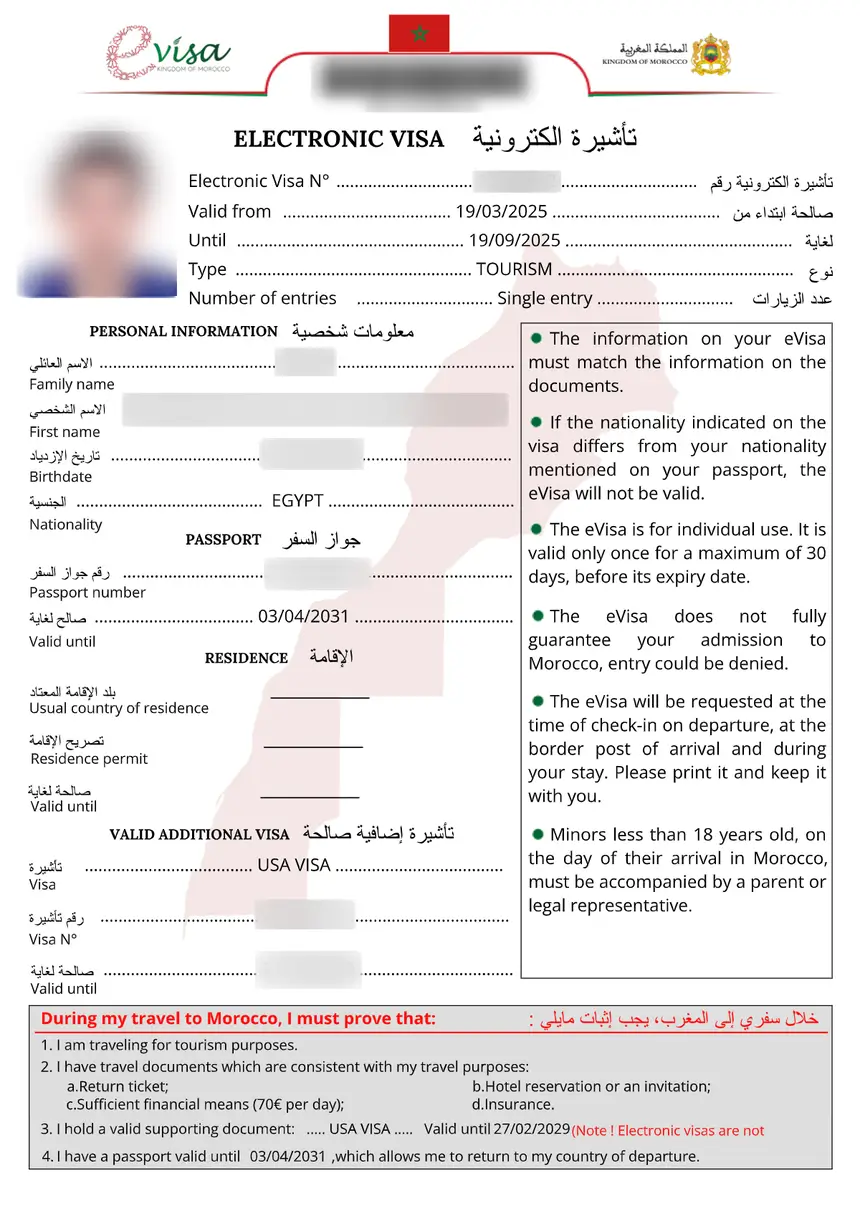
Citizens of certain countries can apply for a Morocco eVisa online through the official Acces Maroc portal. The eVisa is valid for 30 days of stay, with 180 days from the date of issuance. Learn more in our Morocco visa types guide.
Embassy Visa Required
Citizens of some countries must apply for a visa at a Moroccan embassy or consulate before traveling. This applies to nationalities not covered by the visa-free or eVisa arrangements.
For full details on fees and application processes, see our Morocco visa fees breakdown.
Documents to Carry at the Border
Beyond your passport, Moroccan immigration officers may ask to see additional documents. While not all are strictly mandatory under every circumstance, having them ready will speed up your entry.
Always Required
- Valid passport meeting the validity and condition requirements above
- Completed arrival card (fiche de police) – usually provided on the plane or handled by your accommodation
Strongly Recommended
- Return or onward ticket proving you plan to leave within your permitted stay
- Proof of accommodation: hotel booking, riad reservation, or a host’s invitation letter
- Proof of sufficient funds: bank statements, credit cards, or cash
Situation-Specific Documents
- Business travelers: Invitation letter from a Moroccan company or organization
- Students: Enrollment confirmation from a Moroccan educational institution
- Minors (under 18): Notarized parental consent letter if traveling without both parents, especially if the minor has a different surname from the accompanying adult
- Dual nationals: Moroccan law considers anyone with Moroccan parentage to be a Moroccan citizen. If you hold dual nationality, Moroccan citizenship takes precedence, and you may be subject to different rules.
Health and Vaccination Requirements
As of 2026, Morocco does not require routine vaccinations for most travelers. However, there is one important exception:
- Polio certificate: If you are arriving from a polio-affected country, you must present a valid polio vaccination certificate at the border.
Recommended Vaccinations (Not Mandatory)
The following are recommended by the US CDC and travel health professionals:
- Hepatitis A – recommended for all travelers
- Hepatitis B – recommended for extended stays
- Typhoid – especially if eating street food or visiting rural areas
- Routine vaccines – MMR, tetanus, flu, COVID-19 should be up to date
Health Declaration
Morocco requires all passengers to complete a health declaration within 72 hours before their flight. This is a digital form available on the Moroccan government’s health portal.
Customs and Currency Rules
Understanding Morocco’s customs rules prevents problems at the border.
Moroccan Dirham (MAD)
- You can bring in up to 2,000 MAD (~$200 USD) in Moroccan dirhams
- The dirham is a non-convertible currency – you cannot exchange it outside Morocco
- Convert any remaining dirhams back to foreign currency before departure using official exchange receipts
Foreign Currency
- There is no limit on foreign cash you can carry
- Amounts over 100,000 MAD equivalent (~$10,000 USD) must be declared at customs
Customs Allowances
- Alcohol: up to 1 bottle of spirits and 1 bottle of wine
- Tobacco: up to 200 cigarettes or 50 cigars or 250g of tobacco
- Drones: require advance authorization from Moroccan civil aviation authorities – undeclared drones will be confiscated
Entry Points into Morocco
Morocco has multiple official entry points for international travelers:
Airports
- Mohammed V International Airport, Casablanca (CMN) – main international hub
- Marrakech Menara Airport (RAK) – popular for southern Morocco
- Fez-Saiss Airport (FEZ) – northern Morocco gateway
- Agadir Al Massira Airport (AGA) – Atlantic coast
- Nador International Airport (NDR)
- Tangier Ibn Battouta Airport (TNG)
- Rabat-Sale Airport (RBA)
- Ouarzazate Airport (OZZ)
Seaports
- Tangier Med – main ferry port (connections to Spain, France)
- Casablanca port
- Agadir port
Land Borders
- Morocco-Algeria border – currently closed to most travelers
Private Boats
If you arrive by private boat, you must enter at a recognized port of entry listed at anp.org.ma. Entering through any other point is illegal.
Overstaying Your Visa
Overstaying your permitted stay in Morocco is taken seriously. Consequences can include:
- Financial fines
- Detention at the airport
- A deportation order
- A re-entry ban
How to Extend Your Stay
If you need more than 90 days, you must request an extension at a local police station (commissariat) before your 90-day period expires. Extensions are not guaranteed and are evaluated on a case-by-case basis. Applying early gives you time to arrange departure if the extension is denied.
Passport Tips for a Smooth Arrival
These practical tips help you avoid the most common problems at Moroccan immigration.
Before You Leave Home
- Check your passport expiry date and calculate whether it meets the six-month rule
- Make two photocopies of your passport photo page – carry one separately from your original and leave one with someone at home
- Save a digital photo of your passport on your phone (offline storage)
- Register with your country’s traveler enrollment program (US: STEP at travel.state.gov)
- Check that your passport has no water damage, torn pages, or peeling laminate
At the Airport
- Ensure you get your passport stamped on arrival – travelers have reported difficulties leaving Morocco without an entry stamp
- Keep your passport in your carry-on luggage, not checked bags
- Have your return ticket and accommodation details accessible on your phone or printed
During Your Stay
- Carry a photocopy of your passport when exploring cities – leave the original in your hotel safe
- You will need your passport for currency exchange transactions at banks and exchange bureaus
- Your accommodation will ask for your passport at check-in for the fiche de police registration form
Frequently Asked Questions
Does Morocco require 6 months on a passport?
Yes, for most nationalities including US citizens, Morocco requires your passport to be valid for at least six months from your date of entry. UK citizens need only three months validity beyond their arrival date. Always check your country’s specific travel advisory before booking.
Can US citizens enter Morocco without a visa?
Yes. US citizens do not need a visa for tourist stays of up to 90 days in Morocco. You only need a valid US passport with at least six months of remaining validity and two blank pages. No prior visa application or electronic authorization is required.
How many blank pages do I need in my passport for Morocco?
You should have at least two blank pages available in your passport. Morocco stamps your passport on both arrival and departure, and border officials need space for their official stamps. If your passport is running low on blank pages, renew it before your trip.
What happens if my passport is damaged before traveling to Morocco?
Moroccan authorities deny entry to travelers with damaged passports. Water damage, torn pages, peeling laminate, and obscured machine-readable zones are all grounds for refusal. If your passport shows any of these signs, apply for a replacement well before your trip.
Do I need a return ticket to enter Morocco?
A return or onward ticket is not a strict legal requirement but is strongly recommended. Immigration officers may ask for proof that you plan to leave within your permitted stay (usually 90 days). Airlines may also require a return ticket before allowing you to board.
Can I extend my stay beyond 90 days in Morocco?
Yes, but you must apply for an extension at a local police station (commissariat) before your 90-day period expires. Extensions are evaluated individually and are not guaranteed. Overstaying without an extension can result in fines, detention, and a re-entry ban.
What vaccinations do I need for Morocco?
As of 2026, Morocco does not require routine vaccinations for most travelers. The only mandatory requirement is a polio certificate if you are arriving from a polio-affected country. Hepatitis A, Hepatitis B, and Typhoid vaccinations are recommended but not required.
Do I need to declare money when entering Morocco?
You can bring in up to 2,000 MAD (~$200) in Moroccan dirhams. Foreign currency amounts over 100,000 MAD equivalent (~$10,000 USD) must be declared at customs. There is no limit on foreign cash you can carry, but amounts above the threshold must be declared.
Can dual nationals enter Morocco on their foreign passport?
Moroccan law considers anyone with Moroccan parentage to be a Moroccan citizen, regardless of other nationalities. If you hold dual nationality (Moroccan and another), Moroccan citizenship takes precedence. You may be subject to different entry rules and should check with the Moroccan consulate before traveling.
What is the fiche de police in Morocco?
The fiche de police is a police registration form that all visitors must complete when checking into accommodation in Morocco. Hotels, riads, and guesthouses handle this process – you will be asked to provide your passport details at check-in. This is a standard administrative requirement, not a special registration.
What to Do If You Are Denied Entry
If you arrive in Morocco and are denied entry due to passport issues, here is what to expect:
- You will be held at the airport until the next available return flight
- Your airline is responsible for transporting you back to your departure point
- The cost of the return flight may be charged to you or your airline, depending on the circumstances
- You may be able to apply for an emergency passport at your country’s embassy in Morocco, but this does not guarantee entry
To avoid this scenario, verify your passport meets all requirements at least two months before your trip. If you need to renew, standard passport processing takes 6-8 weeks in most countries.
Summary of Morocco Passport Requirements
| Requirement | Details |
|---|---|
| Passport validity | 6 months from arrival (most nationalities); 3 months (UK) |
| Blank pages | At least 1-2 for entry and exit stamps |
| Passport condition | Undamaged – no water damage, torn pages, or peeling laminate |
| Visa | Not required for tourism up to 90 days (many nationalities) |
| Return ticket | Strongly recommended, not strictly mandatory |
| Accommodation proof | Recommended – hotel booking or host invitation |
| Funds proof | Occasionally requested – credit card or bank statement |
| Vaccination | Polio certificate if from affected country; others recommended |
| Currency limit | 2,000 MAD max dirhams; declare foreign cash over 100,000 MAD |
| Health declaration | Required within 72 hours before flight |
For more information on visa types and the eVisa application process, explore our related guides:
- Morocco Visa Types – complete overview of all visa categories
- Morocco Visa-Free Countries – full list of visa-exempt nationalities
- Morocco Visa Fees – cost breakdown for all visa types