The Morocco tourist visa allows foreign nationals to enter Morocco for leisure travel, sightseeing, and personal visits. Citizens of over 70 countries, including the US, UK, Canada, Australia, and all EU states, can visit Morocco visa-free for up to 90 days. All other nationalities must obtain a tourist visa through the e-Visa portal at acces-maroc.ma or apply at a Moroccan embassy. This guide covers every Morocco tourist visa type, the full document checklist, step-by-step application instructions, fees, processing times, and answers to the most common questions.
Who Needs a Tourist Visa for Morocco?
Morocco grants visa-free entry to citizens of more than 70 countries and territories for tourism stays of up to 90 days. Whether you need a tourist visa depends entirely on your nationality. The Moroccan government divides travellers into three categories: visa-exempt nationalities, e-Visa eligible nationalities, and nationalities that must apply at an embassy.
visa-free countries (Up to 90 Days)
Citizens of the following groups can enter Morocco without any visa for tourism stays of up to 90 days with a valid passport:
- All 27 European Union member states
- All European Free Trade Association (EFTA) states: Iceland, Liechtenstein, Norway, Switzerland
- All Gulf Cooperation Council (GCC) states: Bahrain, Kuwait, Oman, Qatar, Saudi Arabia, UAE
- Americas: Argentina, Brazil, Canada, Chile, Mexico, Peru, United States, Venezuela
- Asia-Pacific: Australia, China, Hong Kong, Indonesia, Japan, New Zealand, Philippines, Russia, Singapore, South Korea, Turkey
- Africa: Algeria, Congo, Cote d’Ivoire, Gabon, Guinea, Mali, Niger, Senegal, Tunisia
- Others: Andorra, Monaco, San Marino, Azerbaijan, Burkina Faso
Some nationalities receive shorter visa-free periods: 60 days for select countries or 30 days within any 180-day period for others. Check the official Acces Maroc portal to confirm your specific duration.
AEVM (Electronic Travel Authorization)
Nationals of certain visa-exempt countries must obtain an Authorisation Electronique Voyage Maroc (AEVM) before entering Morocco. This electronic travel authorization applies to citizens of:
- Republic of Congo
- Ecuador
- Ghana
- Guinea
The AEVM is processed through the same Acces Maroc portal as the e-Visa. Morocco plans to expand AEVM requirements to all visa-exempt nationalities in the future.
e-Visa Eligible Countries
If your country is not visa-exempt, you may qualify for the Morocco e-Visa. There are two eligibility categories:
Regular e-Visa (no additional documents required): Citizens of Benin, Brunei Darussalam, Cambodia, Guatemala, India, Israel, Jordan, Laos, Thailand, and Vietnam can apply with only their passport and a photograph.
Conditional e-Visa (requires qualifying visa or residence permit): Citizens of most other non-exempt countries can apply if they hold a valid multiple-entry visa or residence permit from a Schengen country, Australia, Canada, Ireland, Japan, New Zealand, UAE (residence permit only), UK, or United States. The qualifying document must be physically stamped in your passport and valid for at least 90 days (sticker visa) or 180 days (residence permit).
Countries That Cannot Apply for e-Visa
Citizens of Iran, Kosovo, Palestine, Syria, Taiwan, and Tuvalu are not eligible for either regular or conditional e-Visa. These nationalities must apply through a Moroccan embassy or consulate. Additionally, nationals of Afghanistan, Iran, Iraq, Kosovo, Lebanon, Libya, North Korea, Pakistan, Palestine, Syria, and Taiwan require additional approval from the Moroccan Ministry of Interior.
Morocco Tourist Visa Types
Morocco offers three main tourist visa categories: the e-Visa for online applications, the consular tourist visa for embassy applications, and the transit visa for layover travellers. Each type has different eligibility rules, stay durations, and application processes.
Tourist e-Visa
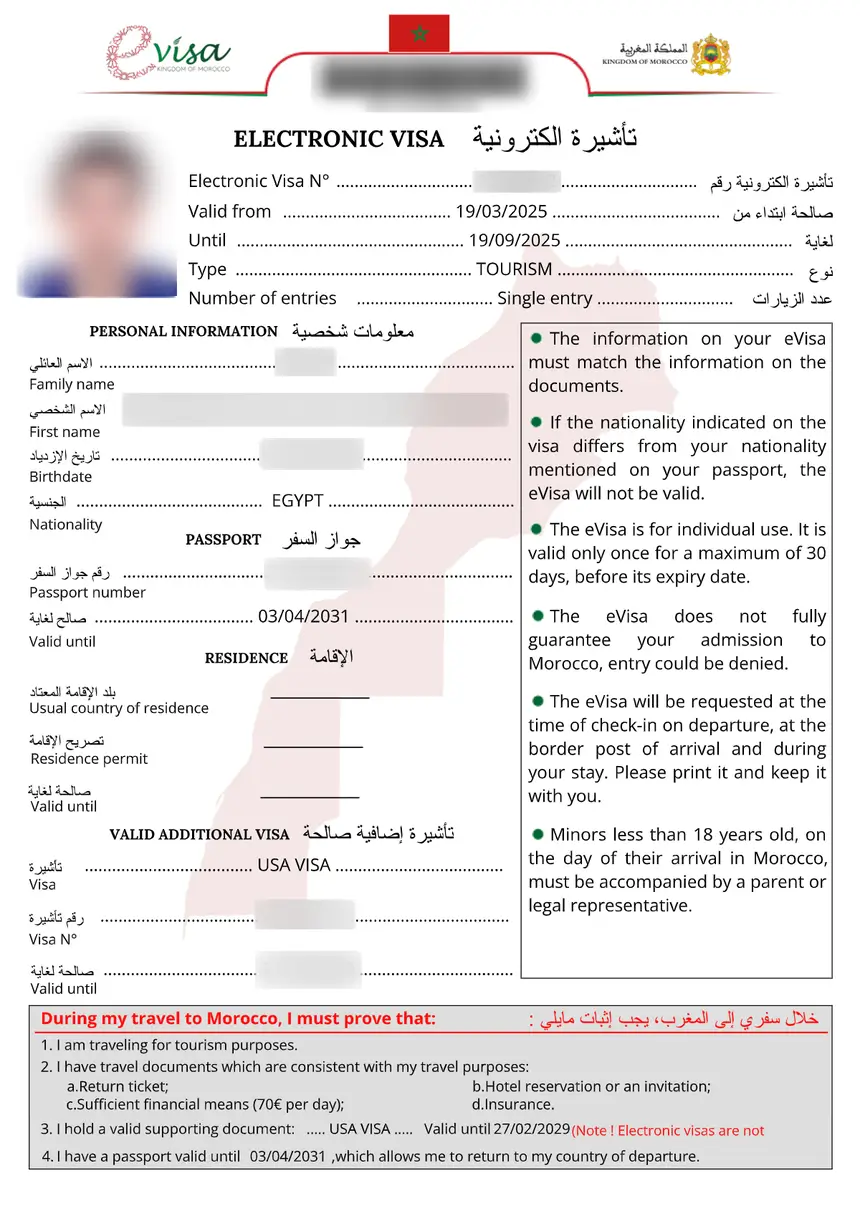
The Morocco tourist e-Visa is the most convenient option for eligible nationalities. Key features:
- Validity: 180 days from the date of issuance
- Stay duration: Up to 30 days per visit
- Entry type: Single entry (convertible to multiple entry in Morocco)
- Extension: Possible up to 180 days total stay
- Processing time: 24 to 72 hours
- Application portal: acces-maroc.ma
The e-Visa is available only to citizens of eligible countries. If you qualify, the entire application process happens online with no embassy visit required.
Consular Tourist Visa
If you are not eligible for the e-Visa, you must apply for a consular tourist visa at a Moroccan embassy or consulate in your country of residence. The consular tourist visa offers:
- Single entry: Stay up to 90 days (fee: DH 220, approximately USD 23)
- Double entry: Stay up to 90 days (fee: DH 330, approximately USD 34)
- Processing time: Typically 10 business days (may be longer during busy periods)
- Application: In person at a Moroccan embassy or consulate
The consular visa requires more documentation than the e-Visa and takes longer to process. However, it allows longer stays and may be issued as a multiple-entry visa.
Transit Visa
The Morocco transit visa is for travellers passing through Morocco on their way to a third country. It costs DH 170 (approximately USD 18) and is valid for the transit period only. You cannot leave the airport or stay beyond the permitted transit time. If you wish to leave the airport or stay longer, you must obtain a tourist visa or e-Visa instead.
Morocco Tourist Visa Requirements & Documents
Every Morocco tourist visa application requires a valid passport, a recent photograph, and supporting documents depending on your nationality and visa type. The document checklist varies based on whether you are applying for an e-Visa or a consular visa.
Required Documents for All Applicants
- Passport bio-data page – Must be valid for at least 3 months (consular visa) or 6 months (e-Visa) beyond your arrival date. The scan must clearly show your name, date of birth, passport number, MRZ code, and issuing authority.
- Recent passport-size photograph – Taken within the last 6 months, in colour, with a plain white or off-white background, showing your full face facing forward with a natural expression.
- Return or onward flight ticket – Proof that you intend to leave Morocco before your visa expires.
- Proof of accommodation – Hotel reservation, rental agreement, or an invitation letter from a host in Morocco.
- Proof of sufficient funds – Bank statements showing you can cover your expenses during your stay.
Additional Documents for Conditional e-Visa Applicants
If you are applying under the conditional e-Visa category (based on a qualifying visa or residence permit), you must also upload:
- Valid residence permit – Issued by a Schengen country, Ireland, US, Australia, UK, UAE, Canada, Japan, or New Zealand, valid for at least 180 days from the application date.
- Multiple-entry sticker visa – A physical visa stamped in your passport, valid for at least 90 days from the application date, issued by the same countries listed above.
UK-Specific Document Rules
Applicants using a UK residence permit (BRP) must also provide a valid UK Immigration Status Share Code. The immigration status must be valid for at least 180 days from the submission date. UK ETA documents are not accepted as qualifying supporting documents for the Morocco e-Visa.
Additional Documents for eTA Applicants
Applicants for the Morocco eTA (Electronic Travel Authorization) must upload bank statements from the last 3 months showing sufficient available balance and continuous financial transactions.
Documents Required for Consular Visa
If applying at a Moroccan embassy, you will typically need all of the above plus:
- Completed visa application form – Available from the embassy or consulate
- Travel insurance – Covering your entire stay in Morocco
- Employment verification – Letter from your employer or proof of self-employment
- Criminal record check – From your country of residence (for long-stay visas)
How to Apply for Morocco Tourist Visa Online
The Morocco tourist e-Visa application is completed entirely online through the official Acces Maroc portal at acces-maroc.ma in six steps. The process takes approximately 15 to 30 minutes and approval typically arrives within 24 to 72 hours.
Step 1: Visit the Official Portal
Go to acces-maroc.ma and click “Apply for an eVisa.” You will first answer a short questionnaire about your nationality, country of residence, document type, and travel purpose to confirm your eligibility.
Step 2: Create an Account
Register on the portal with a valid email address. You will receive a confirmation email to activate your account. Use an email address you check regularly, as all visa communications will be sent there.
Step 3: Fill Out the Application Form
Complete the online form with:
- Personal information – Full name (as it appears on your passport), date of birth, nationality, place of birth
- Passport details – Passport number, issue date, expiry date, issuing country
- Travel information – Expected arrival date, accommodation details, purpose of visit
- Employment details – Current occupation, employer name, or student status
Ensure all information matches your passport exactly. Even small discrepancies can lead to delays or rejection.
Step 4: Upload Required Documents
Upload digital copies of:
- Passport bio-data page – Clear scan or photo, no shadows or reflections
- Recent passport-size photograph – White background, neutral expression, taken within 6 months
- Qualifying visa or residence permit – If applying under the conditional e-Visa category
Accepted file formats are typically JPEG and PDF. Ensure all scans are clear and legible.
Step 5: Pay the Fee Online
Pay the e-Visa processing fee using a credit or debit card. The fee is non-refundable, even if your application is denied. Payment is mandatory before your application can be submitted.
Step 6: Receive Your e-Visa
After submission and payment, your application enters processing. You will receive your approved e-Visa by email within 24 to 72 hours. Download and print the e-Visa document. You must present the printed e-Visa along with your passport upon arrival at a Moroccan port of entry.
Morocco Tourist Visa Fees
Morocco tourist visa fees depend on the visa type, number of entries, and where you apply. The e-Visa fee is paid online by credit or debit card, while consular visa fees are paid at the embassy or consulate.
| Visa Type | Entries | Stay Duration | Fee (MAD) | Fee (USD approx.) |
|---|---|---|---|---|
| Consular Tourist Visa | Single entry | Up to 90 days | DH 220 | USD 23 |
| Consular Tourist Visa | Double entry | Up to 90 days | DH 330 | USD 34 |
| Transit Visa | Single entry | Transit only | DH 170 | USD 18 |
| e-Visa | Single entry | Up to 30 days | Paid online | Check acces-maroc.ma |
The e-Visa fee varies and is displayed during the application process on the Acces Maroc portal. All e-Visa fees are non-refundable. Consular visa fees may vary slightly depending on the embassy and your country of residence.
Additional Costs to Budget For
- Travel insurance – Recommended for all visitors, required for some consular visa applications
- Passport renewal – If your passport expires within 6 months of your travel date
- Document translation – Some embassies require certified translations of supporting documents
- Photograph costs – Passport-size photos meeting Morocco’s specifications
Morocco Tourist Visa Processing Time
The Morocco e-Visa is typically processed within 24 to 72 hours, while consular tourist visas take approximately 10 business days. Processing times may vary depending on your nationality, application completeness, and the time of year.
| Visa Type | Standard Processing | Extended Processing |
|---|---|---|
| e-Visa | 24 to 72 hours | Up to 5 business days |
| Consular Tourist Visa | 10 business days | Up to 30 days |
| Transit Visa | 10 business days | Up to 30 days |
Factors That Affect Processing Time
- Incomplete applications – Missing documents or unclear scans cause delays
- Peak travel seasons – Applications increase before summer and holiday periods
- Nationality – Some nationalities require additional security checks
- Weekend and holiday closures – Moroccan embassies and the e-Visa system may not process applications on weekends or Moroccan public holidays
Tips for Faster Processing
- Apply at least 2 weeks before your travel date for e-Visa, or 4 to 6 weeks for consular visa
- Upload clear, high-quality scans of all documents
- Ensure all information matches your passport exactly
- Check your email (including spam folder) for any requests for additional information
Can You Extend a Morocco Tourist Visa?
Yes, Morocco tourist visas can be extended beyond the initial permitted stay. Visa-free visitors can stay up to 90 days, and extensions may be granted at a Moroccan police station for a total stay of up to 180 days. e-Visa holders can also extend their stay and convert their single-entry visa to a multiple-entry visa while in Morocco.
How to Extend Your Stay
To extend your Morocco tourist visa:
- Visit a local police station (Bureau des Etrangers) before your permitted stay expires
- Bring your passport with valid entry stamp
- Provide proof of accommodation – Hotel booking or rental agreement
- Show proof of sufficient funds – Recent bank statements
- Pay the extension fee – Varies by nationality and extension duration
Important Extension Rules
- You must apply for the extension before your current permitted stay expires
- Overstaying your visa without an extension results in fines and may affect future visa applications
- Extensions are not guaranteed – the police station has discretion to approve or deny your request
- The maximum total stay on a tourist visa (including extensions) is typically 180 days
Morocco Tourist Visa Rejection: Common Reasons
Morocco tourist visa applications can be rejected for several reasons, including incomplete documentation, insufficient funds, or passport validity issues. Understanding the common rejection reasons helps you prepare a stronger application.
Top Reasons for Rejection
- Passport validity less than required – Your passport must be valid for at least 3 months (consular) or 6 months (e-Visa) beyond your arrival date
- Incomplete or unclear documents – Blurry scans, missing pages, or unreadable MRZ codes
- Insufficient proof of funds – Bank statements showing low balances or irregular transactions
- No return ticket – Failure to show intent to leave Morocco before your visa expires
- Previous overstay or visa violation – History of overstaying in Morocco or other countries
- Incorrect information – Discrepancies between your application form and passport details
- Nationality restrictions – Citizens of certain countries face additional scrutiny from the Ministry of Interior
What to Do If Your Application Is Rejected
If your Morocco tourist visa application is rejected:
- Review the rejection reason – The notification email should state why your application was denied
- Correct the issue – Fix any documentation problems or provide missing information
- Reapply – You can submit a new application after addressing the rejection reason
- Contact the embassy – For consular visa rejections, contact the Moroccan embassy for guidance
- Consider an appeal – In some cases, you may be able to appeal the decision through the embassy
Morocco Tourist Visa vs Visa-Free Entry: What Is the Difference?
The main difference between a Morocco tourist visa and visa-free entry is whether you need to obtain authorization before travelling. Visa-exempt nationalities enter with only a valid passport, while others must obtain an e-Visa or consular visa before departure.
| Feature | Visa-Free Entry | e-Visa | Consular Visa |
|---|---|---|---|
| Eligibility | 70+ countries | Eligible nationalities | All nationalities |
| Application | None required | Online (acces-maroc.ma) | In person at embassy |
| Processing time | Instant | 24 to 72 hours | 10 business days |
| Maximum stay | 90 days | 30 days (extendable to 180) | 90 days |
| Cost | Free | Paid online | DH 220 to DH 330 |
| Entry type | Unlimited entries | Single entry | Single or double |
If you are from a visa-exempt country, you do not need to apply for anything before travelling to Morocco. Simply ensure your passport is valid for at least 3 months beyond your arrival date and get your passport stamped at the border.
FAQs About Morocco Tourist Visa
Do I need a tourist visa to visit Morocco?
Whether you need a tourist visa for Morocco depends on your nationality. Citizens of over 70 countries, including the US, UK, Canada, Australia, Japan, and all EU states, can enter Morocco without a visa for up to 90 days. If your country is not on the visa-exempt list, you must apply for an e-Visa at acces-maroc.ma or a consular visa at a Moroccan embassy.
How much does a Morocco tourist visa cost?
The Morocco e-Visa fee is paid online and varies by nationality (check acces-maroc.ma for current pricing). Consular tourist visas cost DH 220 (approximately USD 23) for a single entry and DH 330 (approximately USD 34) for a double entry. Transit visas cost DH 170 (approximately USD 18). All e-Visa fees are non-refundable.
How long does it take to get a Morocco tourist visa?
The Morocco e-Visa is typically processed within 24 to 72 hours. Consular tourist visas take approximately 10 business days but may take up to 30 days during busy periods. It is recommended to apply at least 2 weeks before your travel date for e-Visa or 4 to 6 weeks for consular visa.
Can I extend my Morocco tourist visa?
Yes, Morocco tourist visas can be extended. Visa-free visitors can stay up to 90 days, with extensions possible at a Moroccan police station for a total stay of up to 180 days. e-Visa holders can also extend their stay and convert their single-entry visa to a multiple-entry visa while in Morocco. You must apply for the extension before your current permitted stay expires.
What documents do I need for a Morocco tourist visa?
Every Morocco tourist visa application requires a valid passport (with at least 3 to 6 months validity remaining), a recent passport-size photograph, proof of accommodation, a return or onward flight ticket, and proof of sufficient funds. Conditional e-Visa applicants must also provide a valid qualifying visa or residence permit from a Schengen country, US, UK, Canada, Australia, Japan, or New Zealand.
Can US citizens visit Morocco without a visa?
Yes, US citizens can visit Morocco without a visa for tourism stays of up to 90 days. A valid US passport is sufficient for entry. US citizens do not need an e-Visa or traditional visa for short tourism visits. For stays longer than 90 days or for work purposes, US citizens must apply for the appropriate visa through a Moroccan consulate.
Can UK citizens visit Morocco without a visa?
Yes, UK citizens can visit Morocco without a visa for tourism stays of up to 90 days. Your passport must have an expiry date at least 3 months after your arrival date. You must also get your passport stamped at the border. Some travellers have had difficulties leaving Morocco because their passport had no entry stamp.
What is the difference between the Morocco e-Visa and eTA?
The Morocco e-Visa and eTA (Electronic Travel Authorization) are processed through the same Acces Maroc portal but serve different nationalities. The eTA applies to citizens of select visa-exempt countries (Republic of Congo, Ecuador, Ghana, Guinea) who must obtain authorization before travelling. The e-Visa is for citizens of non-exempt eligible countries. Both allow stays of up to 30 days and are valid for 180 days.
Can I work in Morocco with a tourist visa?
No, the Morocco tourist visa and e-Visa do not permit employment. You cannot hold any job or engage in paid work while in Morocco on a tourist visa. If you wish to work in Morocco, you must apply for a work visa and work permit through a Moroccan consulate before travelling. Working on a tourist visa is a violation of Moroccan immigration law.
What happens if I overstay my Morocco tourist visa?
Overstaying your Morocco tourist visa results in fines and may affect future visa applications. Morocco takes overstays seriously, and you may face detention, a ban on re-entry, or difficulty leaving the country. If you need to stay longer than your permitted duration, visit a local police station before your visa expires to apply for an extension.
How much money can I bring into Morocco?
You can take up to 2,000 Moroccan dirham (MAD) into or out of Morocco. You must declare foreign currency worth 100,000 MAD or more (approximately USD 10,000) when entering or leaving the country. There is no limit on the amount of foreign cash you can carry, but amounts above the threshold must be declared at customs.
Do I need travel insurance for Morocco?
Travel insurance is recommended for all visitors to Morocco and may be required for some consular visa applications. While Morocco does not mandate travel insurance for visa-free visitors or e-Visa holders, having coverage for medical emergencies, trip cancellation, and lost luggage is strongly advised. Morocco has both public and private healthcare facilities, but medical costs for tourists can be significant without insurance.