Morocco welcomes visitors from over 70 countries visa-free for stays up to 90 days, while other nationalities can apply for an e-Visa online through the official Acces Maroc portal at acces-maroc.ma. This guide covers every Morocco visa requirement – from passport validity and document checklists to e-Visa eligibility, consular visa fees, and arrival procedures – so you know exactly what you need before booking your trip.
Who Needs a Visa for Morocco?
Morocco grants visa-free entry to citizens of more than 70 countries and territories, including the United States, United Kingdom, all EU and Schengen states, Australia, Canada, Japan, and most Gulf Cooperation Council (GCC) nations. If your nationality is not on the visa-exempt list, you must obtain a consular visa or qualify for the Morocco e-Visa program.
Morocco visa requirements depend entirely on your nationality. The Moroccan government categorizes travelers into three groups:
- Visa-exempt nationalities – Enter with only a valid passport for up to 90 days (some nationalities receive 60 or 30 days)
- e-Visa eligible nationalities – Apply online at acces-maroc.ma without visiting an embassy
- Consular visa required nationalities – Must apply at a Moroccan embassy or consulate before travel
Visa-Free Countries (90 Days)
Citizens of the following countries and territories can enter Morocco without a visa for up to 90 days:
- All 27 European Union member states
- All European Free Trade Association (EFTA) states: Iceland, Liechtenstein, Norway, Switzerland
- All Gulf Cooperation Council (GCC) states: Bahrain, Kuwait, Oman, Qatar, Saudi Arabia, UAE
- Americas: Argentina, Brazil, Canada, Chile, Mexico, Peru, United States, Venezuela
- Asia-Pacific: Australia, China, Hong Kong, Indonesia, Japan, New Zealand, Philippines, Russia, Singapore, South Korea, Turkey
- Africa: Algeria, Congo, Cote d’Ivoire, Gabon, Guinea, Mali, Niger, Senegal, Tunisia
- Others: Andorra, Monaco, San Marino
Some nationalities receive shorter visa-free periods – 60 days for select countries or 30 days within any 180-day period for others. Check the official Acces Maroc portal to confirm your specific duration.
Electronic Travel Authorization (AEVM)
Nationals of certain visa-exempt countries must obtain an Authorisation Electronique Voyage Maroc (AEVM) before entering Morocco. This electronic travel authorization applies to citizens of:
- Republic of Congo
- Ecuador
- Ghana
- Guinea
The AEVM is processed through the same Acces Maroc portal. Morocco plans to expand AEVM requirements to all visa-exempt nationalities in the future, except for holders of valid Moroccan residence permits, transit passengers, and spouses of Moroccan citizens.
Morocco e-Visa Requirements
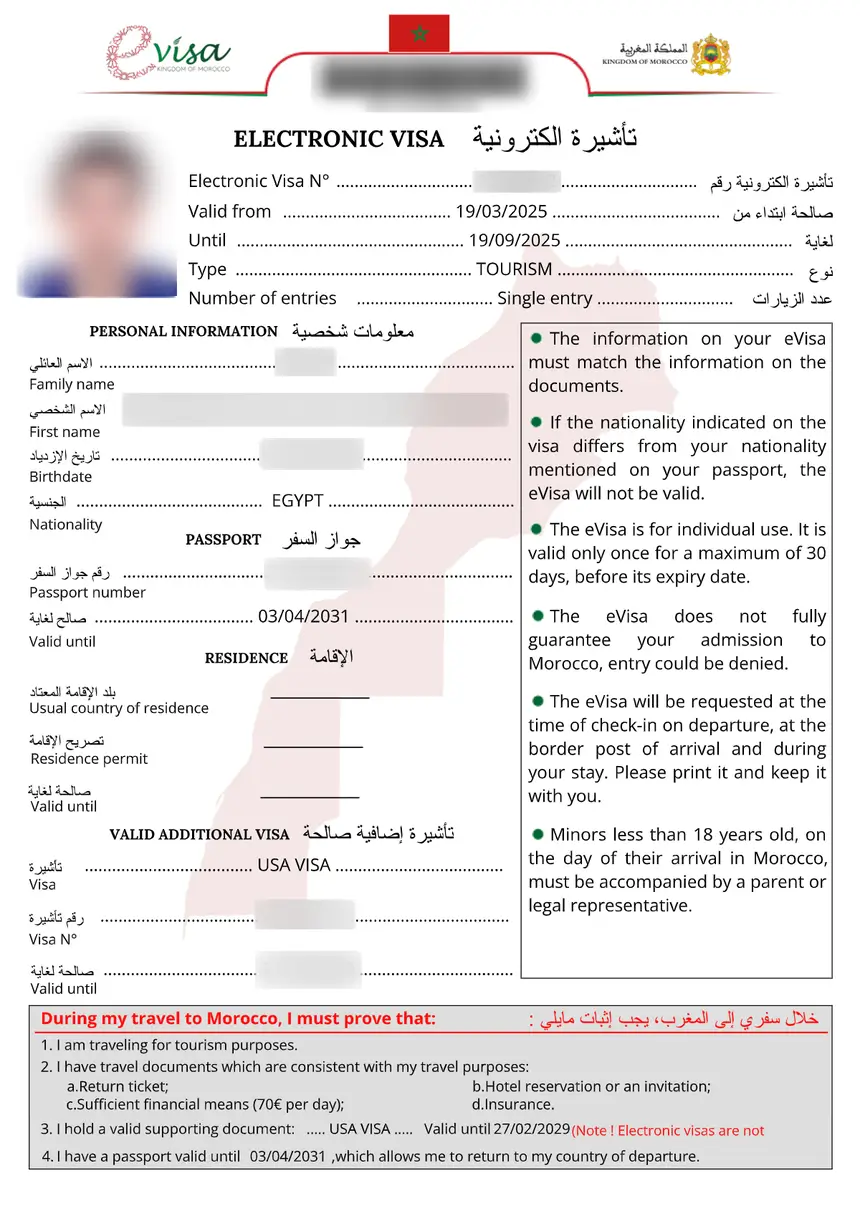
The Morocco e-Visa system, launched on July 10, 2022, allows eligible nationalities to apply for a visa entirely online at acces-maroc.ma without visiting an embassy. The e-Visa permits a single-entry stay of up to 30 days and is valid for 180 days from the date of issuance.
There are two categories of e-Visa eligibility:
Regular e-Visa (No Additional Documents Required)
Citizens of the following countries can apply for a Morocco e-Visa without needing a residence permit or qualifying visa from another country:
- Benin
- Brunei Darussalam
- Cambodia
- Guatemala
- India
- Israel
- Jordan
- Laos
- Thailand
- Vietnam
Conditional e-Visa (Requires Qualifying Visa or Residence Permit)
Citizens of most other non-visa-exempt countries can still apply for a Morocco e-Visa if they hold a valid multiple-entry visa or residence permit from one of the following:
- Any Schengen Area country
- Australia
- Canada
- Ireland
- Japan
- New Zealand
- United Arab Emirates (residence permit only)
- United Kingdom
- United States
The qualifying document must be physically stamped in your passport or be a valid residence card. Digital or electronic visas alone do not qualify. The residence permit must be valid for at least 180 days from the application date, and a multiple-entry sticker visa must be valid for at least 90 days.
Countries That Cannot Apply for e-Visa
Citizens of the following countries are not eligible for either regular or conditional e-Visa and must apply through a Moroccan embassy:
- Iran
- Kosovo
- Palestine
- Syria
- Taiwan
- Tuvalu
Nationals of Afghanistan, Iran, Iraq, Kosovo, Lebanon, Libya, North Korea, Pakistan, Palestine, Syria, and Taiwan require additional approval from the Moroccan Ministry of Interior for any visa application.
Morocco Visa Documents Checklist
Every Morocco visa application – whether e-Visa or consular – requires a valid passport biopage scan and a recent passport-style photograph. Additional documents depend on your nationality and the type of visa you are applying for.
Required Documents for All Applicants
- Passport biopage scan – Must clearly show your name, date of birth, passport number, MRZ code, and issuing authority. Use a clear, full-page scan with no shadows or reflections.
- Applicant photo – Taken within the last 6 months, in color, with a plain white or off-white background, showing your full face facing forward with a natural expression. Do not upload scanned or heavily edited photos.
Supporting Documents for Conditional e-Visa Applicants
If your nationality requires a qualifying visa or residence permit, upload one of the following:
- Residence permit – Valid for at least 180 days from the application date, issued by a Schengen country, Ireland, US, Australia, UK, UAE, Canada, Japan, or New Zealand
- Multiple-entry sticker visa – A physical visa stamped in your passport, valid for at least 90 days from the application date, issued by the same countries listed above
UK-Specific Document Rules
Applicants using a UK residence permit (BRP) must also provide a valid UK Immigration Status Share Code. The immigration status must be valid for at least 180 days from the submission date. UK ETA documents are not accepted as qualifying supporting documents for Morocco e-Visa.
Additional Documents for eTA Applicants
Applicants for the Morocco eTA (Electronic Travel Authorization) must upload bank statements from the last 3 months showing:
- Sufficient available balance
- Continuous financial transactions (salary, transfers, purchases)
- Official bank-issued PDF (mobile screenshots are not accepted)
- At least EUR 70 per day of the planned stay
Additional Documents for Business e-Visa
Business e-Visa applicants must submit one document confirming the purpose of travel:
- An invitation letter from a Moroccan company
- A meeting confirmation
- A business cooperation or partnership document
The document must show your name, organization details, and purpose of visit on official company letterhead, signed and stamped.
Documents for Minors
If traveling with a minor (under 18), submit:
- Guardian’s passport – Clear scanned copy of the parent’s or legal guardian’s passport bio page
- Birth certificate – Clear scanned copy of the minor applicant’s birth certificate
Morocco Passport Requirements
Your passport must be valid for at least 3 months beyond your date of arrival in Morocco, though some sources recommend 6 months of validity as a safer standard. The Moroccan authorities have denied entry to travelers with damaged passports.
Key passport requirements for Morocco:
- Validity – Minimum 3 months from arrival date (per GOV.UK). Some airlines and border officials may require 6 months.
- Condition – Passport must not be damaged. Torn pages, water damage, or faded text can result in denied entry.
- Blank pages – Ensure you have at least one blank page for entry and exit stamps.
- Entry stamp – Make sure the border official stamps your passport upon entry. Some travelers have had difficulties leaving Morocco because their passport had no entry stamp.
- Dual nationals – British dual nationals must carry a valid British passport or certificate of entitlement when returning to the UK.
Passport Validity by Visa Type
| Visa Type | Minimum Passport Validity |
|---|---|
| Visa-free entry (tourism) | 3 months from arrival |
| e-Visa | 3 months from arrival |
| Consular tourist visa | 6 months recommended |
| Organized group tour | Valid for duration of stay |
Morocco Visa Fees
Morocco e-Visa fees are approximately MAD 770 (about USD 77) for the official government processing, while consular visa fees range from MAD 170 for transit visas to MAD 330 for multiple-entry visas. Third-party visa services may charge additional service fees.
Official Morocco Visa Fee Schedule
| Visa Type | Fee (MAD) | Fee (approx. USD) |
|---|---|---|
| Single-entry tourist visa | MAD 220 | ~$23 |
| Double-entry visa | MAD 330 | ~$34 |
| Transit visa | MAD 170 | ~$18 |
| e-Visa (official) | MAD 770 | ~$77 |
Third-party e-Visa processing services (such as moroccan-visa.com) charge approximately USD 90 base fee plus USD 69 service fee, totaling around USD 159. Using the official Acces Maroc portal at acces-maroc.ma is significantly cheaper.
Payment Methods
- e-Visa – Paid online by credit or debit card during the application process
- Consular visa – Payment methods vary by embassy; some accept only bank transfers or money orders
- Fees are non-refundable – Even if your application is rejected, visa fees will not be returned
How Long Does Morocco Visa Processing Take?
Morocco e-Visa applications are typically processed within 24 to 72 hours, while consular visa applications at embassies may take 5 to 15 business days depending on the consulate and nationality. Apply at least 2 weeks before your travel date to allow for any delays.
| Application Method | Typical Processing Time |
|---|---|
| e-Visa (online) | 24-72 hours |
| Consular visa (embassy) | 5-15 business days |
| Express processing (some embassies) | 2-5 business days |
Factors That Affect Processing Time
- Nationality – Some nationalities require additional security clearance from the Ministry of Interior, which extends processing time
- Document quality – Blurry scans, missing documents, or incorrect photo specifications cause delays
- Application volume – Peak travel seasons (summer, holidays) may increase processing times
- Weekend and holidays – Moroccan consulates are closed on weekends and Moroccan public holidays
Morocco Arrival Requirements
When you arrive in Morocco, immigration officers will check your passport, visa (if applicable), return or onward ticket, and may ask for proof of financial means of at least EUR 70 per day of your stay. Having all documents ready speeds up the immigration process.
What to Prepare at the Border
- Valid passport with minimum 3-month validity
- Approved e-Visa printout (if you entered via e-Visa)
- Return or onward flight ticket
- Proof of accommodation – Hotel booking confirmation or invitation letter
- Financial means – Cash, bank statements, or credit cards showing at least EUR 70 per day
- Supporting documents – If you used a residence permit or qualifying visa for your e-Visa application, you must carry that original document and present it at the border
Customs Rules
- You may bring up to 2,000 Moroccan dirham (MAD) into or out of Morocco
- You must declare foreign currency worth 100,000 MAD or more (approximately USD 10,000) when entering or leaving
- There is no limit on foreign cash, but amounts above the threshold must be declared
- Strict rules apply to goods entering Morocco – declare anything that may be prohibited or subject to duty
- The dirham is non-convertible and cannot be easily exchanged outside Morocco
Vaccine Requirements
You must have a polio vaccination certificate if arriving from a polio-affected country. Check the latest health requirements before travel, as regulations may change.
Private Boat Arrivals
If arriving by private boat, you must enter at a recognized port of entry. Entering through other ports is illegal.
Morocco Visa for Specific Nationalities
Visa requirements for Morocco vary significantly by nationality – US, UK, and EU citizens enjoy visa-free entry for 90 days, while Pakistani nationals need Ministry of Interior approval, and Indian citizens can apply for a regular e-Visa. Here are the key requirements for the most-searched nationalities.
Morocco Visa for US Citizens
US citizens do not need a visa for tourism stays of up to 90 days. You need only a valid US passport. For stays longer than 90 days, request an extension at a Moroccan police station. For non-tourism purposes (work, study), check requirements with the Moroccan Embassy in Washington DC.
Morocco Visa for UK Citizens
UK citizens holding a valid British passport can visit Morocco visa-free for up to 90 days for tourism. No visa or e-Visa is required. The passport must have at least 3 months validity beyond the arrival date.
Morocco Visa for Indian Citizens
Indian citizens are eligible for the regular Morocco e-Visa without needing a qualifying visa from another country. Apply online at acces-maroc.ma with a passport scan and photo. The e-Visa allows a single-entry stay of up to 30 days.
Morocco Visa for Pakistani Citizens
Pakistani citizens cannot apply for a Morocco e-Visa. Pakistan is among the countries that require approval from the Moroccan Ministry of Interior. Pakistani nationals must apply for a consular visa at the nearest Moroccan embassy, and processing times are typically longer due to the additional security clearance.
Morocco Visa for Nigerian Citizens
Nigerian citizens are not visa-exempt and are not on the regular e-Visa list. However, Nigerian nationals holding a valid Schengen, US, UK, Canada, Australia, Ireland, Japan, or New Zealand visa or residence permit can apply for a conditional e-Visa. Otherwise, apply at a Moroccan embassy.
Morocco Visa for German Citizens
German citizens enjoy visa-free entry to Morocco for up to 90 days with a valid German passport. No visa, e-Visa, or AEVM is required for tourism. Germany is part of the Schengen Area and EU, both of which have visa exemption agreements with Morocco.
Morocco Transit Visa Requirements
Passengers transiting through Moroccan airports without leaving the international transit area can stay for up to 24 hours without a visa, regardless of nationality. If you need to leave the airport or your transit exceeds 24 hours, you may need a transit visa or a tourist visa.
Transit Visa Types
- Airside transit (no visa needed) – All nationalities may transit without a visa for up to 24 hours while remaining in the international transit area
- Transit visa – For travelers who must enter Moroccan territory during transit; permits a stay of up to 72 hours, usually single-entry. Fee: MAD 170 (~$18)
- Tourist visa or e-Visa – Required if you want to stay beyond the transit period or leave the airport during an extended layover
When You Need a Transit Visa
You need a transit visa if:
- Your connecting flight requires you to pass through Moroccan immigration
- Your layover exceeds 24 hours and you want to leave the airport
- Your nationality requires a visa even for airside transit (check with your airline)
Morocco Visa Extension
Tourists in Morocco can request a visa extension at the nearest police station to stay an additional 90 days beyond the initial visa-free or visa-authorized period, for a maximum total of 180 days. Extensions are granted at the discretion of Moroccan immigration authorities.
How to Extend Your Stay
- Visit the nearest police station (commissariat) before your authorized stay expires
- Bring your passport, a copy of your passport bio page, and proof of accommodation
- Extensions are typically granted in 30-day increments
- Overstaying your authorized period without an extension can result in fines, detention, or a future entry ban
- The maximum total stay (initial + extension) is generally 180 days per calendar year
FAQs About Morocco Visa Requirements
Do US citizens need a visa for Morocco?
No. US citizens can enter Morocco visa-free for up to 90 days for tourism with a valid US passport. No visa, e-Visa, or travel authorization is required. For stays beyond 90 days, request an extension at a Moroccan police station.
How much does a Morocco eVisa cost?
The official Morocco e-Visa costs approximately MAD 770 (about USD 77) when applying through the Acces Maroc portal at acces-maroc.ma. Third-party processing services charge USD 100-160 including service fees. Using the official portal is the cheapest option.
How long does it take to get a Morocco visa?
Morocco e-Visa applications are typically processed within 24 to 72 hours. Consular visa applications at embassies take 5 to 15 business days. Some nationalities requiring Ministry of Interior approval may experience longer processing times.
What documents do I need for a Morocco eVisa?
Every applicant needs a passport biopage scan and a recent passport-style photo. Depending on your nationality, you may also need a valid residence permit or multiple-entry visa from a Schengen country, UK, US, Canada, Australia, Ireland, Japan, or New Zealand. Business applicants need an invitation letter or meeting confirmation.
Can I get a Morocco visa on arrival?
No. Morocco does not offer visa on arrival. If you are not visa-exempt, you must either apply for an e-Visa online before travel or obtain a consular visa from a Moroccan embassy before departure.
Which countries are visa-free for Morocco?
Over 70 countries enjoy visa-free entry to Morocco, including the US, UK, all EU and Schengen states, Australia, Canada, Japan, South Korea, Singapore, Brazil, Argentina, Russia, Turkey, and all GCC nations. Visa-free stays range from 30 to 90 days depending on nationality.
Can Pakistani citizens get a Morocco eVisa?
No. Pakistani citizens cannot apply for a Morocco e-Visa. Pakistan requires approval from the Moroccan Ministry of Interior. Pakistani nationals must apply for a consular visa at the nearest Moroccan embassy or consulate.
What is the difference between Morocco eVisa and eTA?
The Morocco e-Visa is for nationalities that require a visa to enter Morocco. The eTA (Electronic Travel Authorization) is for certain visa-exempt nationalities (Congo, Ecuador, Ghana, Guinea) as a pre-travel registration requirement. Both are processed through the Acces Maroc portal.
Do I need to print my Morocco eVisa?
Yes. While the e-Visa is electronically linked to your passport, you should carry a printed copy of your approved e-Visa when traveling. Immigration officers may request to see a physical copy at the border.
What happens if my Morocco visa application is rejected?
If your Morocco e-Visa application is rejected, visa fees are non-refundable. You can reapply with corrected documents or apply for a consular visa at a Moroccan embassy. Common rejection reasons include invalid documents, expired qualifying visas, or unclear passport scans.
How much money do I need to enter Morocco?
Morocco requires proof of financial means of at least EUR 70 per day of your stay. This can be shown as cash, bank statements, or credit cards. For a 7-day trip, you should have access to at least EUR 490.
Can Indian citizens travel to Morocco without a visa?
No. Indian citizens are not visa-exempt but are eligible for the regular Morocco e-Visa without needing a qualifying visa from another country. Apply online at acces-maroc.ma with a passport scan and photo for a single-entry stay of up to 30 days.