US citizens do not need a visa to enter Morocco for tourism or business stays of up to 90 days. A valid US passport with at least 3 months of remaining validity is the only essential document required at the border. This guide covers everything American travelers need to know about Morocco entry requirements, customs rules, and practical tips for a smooth arrival.
Do US Citizens Need a Visa for Morocco?
No – US citizens are fully exempt from Morocco’s visa requirements. The United States has been on Morocco’s visa-exempt list since March 19, 1956, when the exemption was established as a unilateral Moroccan policy. American passport holders can enter Morocco for tourism, business, or family visits without obtaining any visa, e-Visa, or travel authorization in advance.
This visa-free arrangement covers:
- Tourism – sightseeing, cultural visits, holidays
- Business – meetings, conferences, non-employment business activities
- Family visits – visiting relatives or friends residing in Morocco
- Transit – passing through Morocco en route to another destination
The visa exemption applies to holders of regular US passports. Diplomatic and official passport holders receive the same visa-free treatment. Morocco’s visa policy is managed by the Ministry of Foreign Affairs and covers over 100 countries that enjoy some form of visa exemption.
Key point: If you hold a US passport, you do not need to apply for a Morocco e-Visa, visit an embassy, or complete any pre-travel visa application. Simply book your flight, pack your valid passport, and go. For a full overview of all entry categories, see our guide to Morocco visa types.
Morocco Entry Requirements for US Citizens
US citizens need three things to enter Morocco: a valid passport, a completed health declaration form, and proof of onward or return travel. While no visa is required, Moroccan immigration officers will verify these documents at the border.
Passport Validity
Your US passport must be valid for at least 3 months beyond your planned date of entry into Morocco. This is the official requirement stated by the UK Foreign Office and corroborated by Moroccan consular sources. However, most travel advisories – including the US Department of State – recommend having at least 6 months of passport validity as a general best practice for international travel.
Moroccan authorities have denied entry to travelers with damaged passports. If your passport has water damage, torn pages, or a peeling laminate, renew it before your trip. You also need at least 2 blank pages for entry and exit stamps.
Health Declaration Form
All passengers traveling to Morocco must complete a health declaration form within 72 hours before their flight. This form is submitted online and covers basic health screening questions. Airlines may check for completion before boarding.
Additionally, if you are traveling from a polio-affected country, you must present a valid polio vaccination certificate at the Moroccan border. Morocco does not currently require COVID-19 vaccination proof for entry.
Proof of Return Travel
Moroccan immigration may ask to see a return or onward flight ticket showing your departure from Morocco within the 90-day visa-free window. While this is not always checked, having a printed or digital copy of your booking avoids potential issues at the border.
How Long Can US Citizens Stay in Morocco?
US citizens can stay in Morocco for a maximum of 90 days within any 180-day period without a visa. This 90-day limit applies to all visa-exempt nationalities and is strictly enforced by Moroccan immigration authorities.
The key rules for the 90-day stay:
- 90 consecutive days maximum – the clock starts from your entry date
- 180-day rolling window – after using your 90 days, you must wait before re-entering
- No automatic extension – the 90 days cannot be extended by simply leaving and re-entering Morocco
- Overstay penalties – staying beyond 90 days triggers fines, detention, and potential re-entry bans
If you plan to stay longer than 90 days, you must apply for an extension at a local Moroccan police station before your visa-free period expires. This process is covered in detail below.
Important: Make sure the border officer stamps your passport with an entry date. Some travelers have reported difficulties leaving Morocco because their passport had no entry stamp. If the officer does not stamp your passport, politely request that they do so.
Morocco eVisa: Do US Citizens Need It?
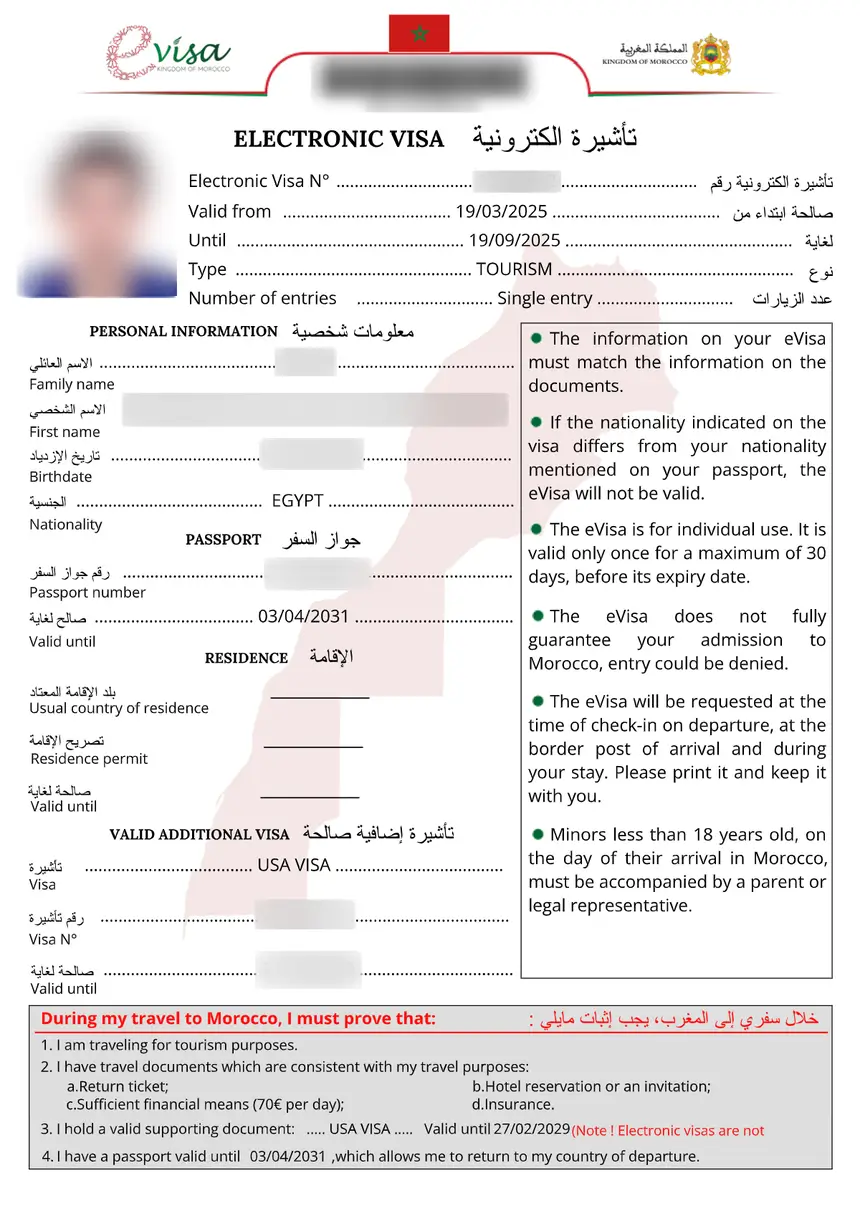
No – US citizens do not need to apply for a Morocco eVisa. The eVisa system, launched on July 10, 2022, was created for nationals of countries that require a visa to enter Morocco. Since the US is on the visa-exempt list, American travelers bypass the eVisa entirely.
The Morocco eVisa is available through the official government portal at ma-visit.com and serves two purposes:
| Feature | eVisa | Visa-Free (US Citizens) |
|---|---|---|
| Required for US citizens | No | N/A |
| Validity | 30 or 90 days | Up to 90 days |
| Application process | Online via ma-visit.com | None required |
| Cost | Varies by nationality | Free |
| Processing time | 24-72 hours | Instant (at border) |
The eVisa is relevant for citizens of over 110 countries that are NOT visa-exempt, including India, Pakistan, Nigeria, China, and many others. US citizens, along with UK, EU, Canadian, Australian, and Japanese passport holders, do not need the eVisa. Citizens of visa-required countries can learn more in our guides for Morocco visa for Indian citizens and Morocco visa for Nigerian citizens.
Note: Morocco is developing an Electronic Travel Authorization (AEVM) system that may eventually require visa-exempt travelers to register before arrival. As of 2026, the AEVM applies only to select nationalities (Republic of the Congo, Ecuador, Ghana, Guinea) and does not apply to US citizens. Monitor official Moroccan government announcements for any changes.
Morocco Passport Requirements for US Citizens
Your US passport must meet three conditions for Morocco entry: validity of at least 3 months beyond arrival, at least 2 blank pages, and no physical damage. Failing any of these conditions can result in denied boarding or entry refusal.
Passport Validity Breakdown
| Requirement | Minimum | Recommended |
|---|---|---|
| Validity remaining | 3 months beyond entry date | 6 months beyond entry date |
| Blank pages | 2 for stamps | 4+ for multiple entries |
| Condition | No damage, readable biographical page | Pristine condition |
Damaged Passport Policy
Moroccan authorities have denied entry to travelers with damaged passports. Types of damage that can cause problems:
- Water damage or warping
- Torn or loose pages
- Peeling or separating laminate on the biographical page
- Faded or unreadable text
- Unauthorized markings or stamps
If your passport shows any of these signs, renew it before your trip. US passport renewal takes 6-8 weeks for routine processing or 2-3 weeks for expedited service.
Dual Nationals
Morocco recognizes dual nationality, but Moroccan citizenship takes legal precedence over other nationalities. If you hold both US and Moroccan citizenship, Moroccan law applies to you while in Morocco. This can affect:
- Military service obligations – male dual nationals may be subject to conscription
- Child custody disputes – Moroccan family law may take precedence
- Exit requirements – you may need to resolve legal matters before leaving
If you are a dual US-Moroccan national, always carry both passports and consult the Moroccan Embassy before traveling.
Customs Rules and Cash Limits for Morocco
US citizens can bring up to 2,000 Moroccan dirhams (MAD) in cash into or out of Morocco. Foreign currency must be declared if it exceeds 100,000 MAD (approximately $10,000 USD). There is no limit on the amount of foreign cash you can carry, but amounts above the threshold must be declared.
Cash and Currency Rules
| Item | Limit | Declaration Required |
|---|---|---|
| Moroccan dirhams (MAD) | 2,000 MAD (~$200 USD) | No |
| Foreign currency (USD, EUR, etc.) | No limit | If exceeding 100,000 MAD (~$10,000 USD) |
| Moroccan dirhams are non-convertible | Cannot easily exchange MAD outside Morocco | Spend remaining MAD before departure |
What You Must Declare
- Foreign currency exceeding 100,000 MAD (about $10,000 USD)
- Goods that may be prohibited or subject to tax or duty
- Electronics – Moroccan customs may ask about high-value electronics
- Gifts – items intended as gifts may be subject to duties
Prohibited and Restricted Items
Morocco has strict rules about items you can bring into or out of the country:
- Drugs – Morocco has severe penalties for drug offenses, including lengthy prison sentences
- Religious materials – restrictions on materials intended for proselytizing
- Drone equipment – importing drones requires special authorization
- Pornographic material – prohibited
- Alcohol – limits apply; not permitted in large quantities
The Moroccan customs authority (Administration des Douanes et Impots Indirects) provides detailed guidance in French at douane.gov.ma.
How to Extend Your Stay Beyond 90 Days
US citizens who want to stay in Morocco for more than 90 days must visit a local police station (commissariat) to request an extension before their visa-free period expires. There is no online extension process, and the request must be made in person.
Extension Process
- Visit a local police station – go to the commissariat nearest to your accommodation
- Bring your passport – original passport with valid entry stamp
- Provide a reason – tourism, medical, family emergency, business
- Submit accommodation proof – hotel booking or host invitation letter
- Await processing – extensions are granted at the discretion of local authorities
Important Extension Notes
- Extensions are not guaranteed – approval depends on your reason and local authority discretion
- Apply well before your 90 days expire – last-minute requests may be denied
- Overstaying while waiting for an extension decision is still a violation
- If an extension is denied, you must leave Morocco immediately
For stays exceeding 90 days for work, study, or long-term residency purposes, you must apply for the appropriate visa at a Moroccan embassy or consulate before entering Morocco. The visa-free exemption does not cover employment, academic study, or permanent residence. For details on visa fees, see our Morocco visa fees breakdown.
What Happens if You Overstay in Morocco?
Overstaying the 90-day visa-free period in Morocco carries serious penalties, including financial fines, detention, deportation orders, and bans on re-entering the country. Moroccan authorities take overstays seriously, and violators cannot leave the country until they regularize their immigration status.
Overstay Penalties
| Duration of Overstay | Likely Consequence |
|---|---|
| 1-7 days | Fine; warning; possible difficulty re-entering |
| 1-4 weeks | Heavier fine; possible deportation order |
| 1-3 months | Significant fine; detention; formal deportation |
| 3+ months | Severe fine; deportation; multi-year re-entry ban |
How to Resolve an Overstay
If you have overstayed your visa-free period in Morocco:
- Go to the nearest police station – do not wait to be caught at the airport
- Explain your situation – bring proof of flight booking showing intent to leave
- Pay the fine – fines vary by duration and circumstances
- Obtain a written exit permit – the police station will issue documentation allowing you to depart
- Present the exit permit at the airport – immigration officers will check it before allowing you to board
Practical Warning
Some travelers have been stopped at the airport during departure and prevented from leaving because their passport lacked an entry stamp. Without proof of when you entered Morocco, authorities cannot calculate your remaining days. This is why getting your passport stamped at entry is critical.
Practical Travel Tips for US Citizens Visiting Morocco
Before your trip to Morocco, enroll in the US Embassy’s STEP program, carry copies of your travel documents, and understand basic customs protocols. These practical steps will help you avoid common problems and ensure a smooth journey.
Before You Go
- Enroll in STEP – the Smart Traveler Enrollment Program (STEP) at step.state.gov registers your trip with the US Embassy in Rabat and provides emergency alerts
- Check your passport expiry – ensure at least 3 months validity (6 months recommended) from your entry date
- Make copies of documents – carry photocopies of your passport, flight bookings, and hotel reservations separately from originals
- Purchase travel insurance – medical care in Morocco varies in quality; insurance covers evacuation and emergency treatment
At the Border
- Get your passport stamped – verify the entry date stamp before leaving the immigration counter
- Declare cash if required – foreign currency over $10,000 USD equivalent must be declared
- Have your return ticket ready – immigration officers may ask for proof of onward travel
- Complete the health declaration – submit online within 72 hours before your flight
Currency and Money
- Moroccan dirham (MAD) is the official currency – $1 USD is approximately 10 MAD
- ATMs are widely available in cities and tourist areas – best exchange rates
- Credit cards accepted at hotels, restaurants, and larger shops
- Carry some cash for medinas, small shops, taxis, and tips
- Cannot exchange MAD outside Morocco – dirhams are non-convertible; spend or exchange before departure
Safety and Culture
- Morocco is generally safe for US tourists, but exercise normal precautions in crowded areas
- Respect local customs – Morocco is a Muslim-majority country; dress modestly in non-tourist areas
- Photography restrictions – avoid photographing military installations, government buildings, or individuals without permission
- Alcohol – available in licensed establishments; public intoxication is discouraged
FAQs About Morocco Visa for US Citizens
Do US citizens need a visa for Morocco in 2026?
No. US citizens do not need a visa for Morocco. The United States is on Morocco’s visa-exempt list, allowing American passport holders to enter Morocco for up to 90 days without any visa or travel authorization. This exemption has been in place since 1956.
How long can a US citizen stay in Morocco without a visa?
US citizens can stay in Morocco for a maximum of 90 days within any 180-day period without a visa. This limit applies to tourism, business, and family visits. Staying beyond 90 days without an extension is a violation of Moroccan immigration law.
What documents do US citizens need to enter Morocco?
US citizens need three documents to enter Morocco: a valid US passport with at least 3 months of remaining validity, a completed health declaration form submitted online within 72 hours before the flight, and proof of return or onward travel. No visa, e-Visa, or travel authorization is required.
Can US green card holders travel to Morocco without a visa?
A US green card (permanent residency) does not grant visa-free access to Morocco. Green card holders must check the visa requirements based on their actual nationality (passport), not their US residency status. Citizens of visa-required countries will need to apply for a Morocco e-Visa or consular visa.
How long does my passport need to be valid for Morocco?
Your US passport must be valid for at least 3 months beyond your date of entry into Morocco. However, most travel advisories recommend 6 months of validity as a general rule for international travel. You also need at least 2 blank pages for immigration stamps.
Do I need a return ticket to enter Morocco?
Moroccan immigration may ask to see a return or onward flight ticket showing your departure from Morocco within the 90-day visa-free window. While not always checked, having a printed or digital copy of your booking avoids potential issues at the border.
What happens if I overstay my 90 days in Morocco?
Overstaying the 90-day visa-free period in Morocco can result in a financial fine, detention, a deportation order, and a ban on re-entering the country. You will not be allowed to leave Morocco until you regularize your immigration status at a local police station. Penalties increase with the duration of overstay.
Can I extend my stay beyond 90 days in Morocco?
Yes, US citizens can request an extension by visiting a local Moroccan police station (commissariat) before the 90-day period expires. Extensions are granted at the discretion of local authorities and are not guaranteed. For stays longer than 90 days for work or study, you must obtain a visa at a Moroccan embassy before entering.
How much cash can I bring into Morocco?
You can bring up to 2,000 Moroccan dirhams (MAD), approximately $200 USD, into Morocco. Foreign currency has no limit but must be declared if it exceeds 100,000 MAD (about $10,000 USD). Moroccan dirhams are non-convertible and cannot be easily exchanged outside Morocco.
Is Morocco safe for American tourists?
Morocco is generally safe for US tourists. The US Department of State rates Morocco as Level 2 (Exercise Increased Caution). Standard precautions apply: avoid isolated areas at night, watch for pickpockets in crowded medinas, and be cautious of unsolicited guides. The US Embassy in Rabat provides consular services for American citizens.
Do I need travel insurance for Morocco?
Travel insurance is not a legal requirement for entering Morocco, but it is strongly recommended. Medical care quality varies across Morocco, and evacuation to a well-equipped facility can be expensive. Comprehensive travel insurance covering medical emergencies, trip cancellation, and lost luggage is advisable for all US travelers.