French citizens do not need a visa to enter Morocco for tourism or business stays of up to 90 days. A valid French passport with at least 3 months of remaining validity is all that is required at the border. This guide covers everything French travelers need to know about Morocco entry requirements, practical travel tips, and what to do if you plan to stay longer.
Do French Citizens Need a Visa for Morocco?
No – French citizens are fully exempt from Morocco’s visa requirements. France has been on Morocco’s visa-exempt list since August 25, 1957, making it one of the earliest countries to receive this exemption. As an EU member state, France benefits from Morocco’s broad visa waiver for European Union nationals.
This visa-free arrangement covers:
- Tourism – sightseeing, cultural visits, holidays, and Sahara desert tours
- Business – meetings, conferences, trade fairs, and non-employment activities
- Family visits – visiting relatives or friends residing in Morocco
- Transit – passing through Morocco en route to another destination
The exemption applies to holders of regular French passports. Diplomatic and official passport holders receive the same visa-free treatment. Morocco’s visa policy is managed by the Ministry of Foreign Affairs, African Cooperation, and Moroccan Expatriates (MAECI).
Key point: If you hold a French passport, you do not need to apply for a Morocco e-Visa, visit an embassy, or complete any pre-travel visa application. Simply book your flight and go. For a full overview of all visa categories, see our guide to Morocco visa types.
Morocco Entry Requirements for French Citizens
French citizens need three things to enter Morocco: a valid passport, a completed health declaration form, and proof of onward or return travel. While no visa is required, Moroccan immigration officers will verify these documents at the border.
Passport Validity
Your French passport must be valid for at least 3 months beyond your planned date of entry into Morocco. This is the official requirement stated by the UK Foreign Office and corroborated by Moroccan consular sources. However, most travel advisories recommend having at least 6 months of passport validity as a general best practice for international travel.
Moroccan authorities have denied entry to travelers with damaged passports. If your passport has water damage, torn pages, or a peeling laminate, renew it before your trip. You also need at least 2 blank pages for entry and exit stamps.
Health Declaration Form
All passengers traveling to Morocco must complete a health declaration form within 72 hours before their flight. This form is submitted online and covers basic health screening questions. Airlines may check for completion before boarding.
Additionally, if you are traveling from a polio-affected country, you must present a valid polio vaccination certificate at the Moroccan border. Morocco does not currently require COVID-19 vaccination proof for entry.
Proof of Return Travel
Moroccan immigration may ask to see a return or onward flight ticket showing your departure from Morocco within the 90-day visa-free window. While this is not always checked, having a printed or digital copy of your booking avoids potential issues at the border.
How Long Can French Citizens Stay in Morocco?
French citizens can stay in Morocco for a maximum of 90 days within any 180-day period without a visa. This 90-day limit applies to all visa-exempt nationalities and is strictly enforced by Moroccan immigration authorities.
The key rules for the 90-day stay:
- 90 consecutive days maximum – the clock starts from your entry date
- 180-day rolling window – after using your 90 days, you must wait before re-entering
- No automatic extension – the 90 days cannot be extended by simply leaving and re-entering Morocco
- Overstay penalties – staying beyond 90 days triggers fines, detention, and potential re-entry bans
If you plan to stay longer than 90 days, you must apply for an extension at a local Moroccan police station (commissariat) before your visa-free period expires. This process is covered in detail below.
Important: Make sure the border officer stamps your passport with an entry date. Some travelers have reported difficulties leaving Morocco because their passport had no entry stamp. If the officer does not stamp your passport, politely request that they do so.
Morocco eVisa: Do French Citizens Need It?
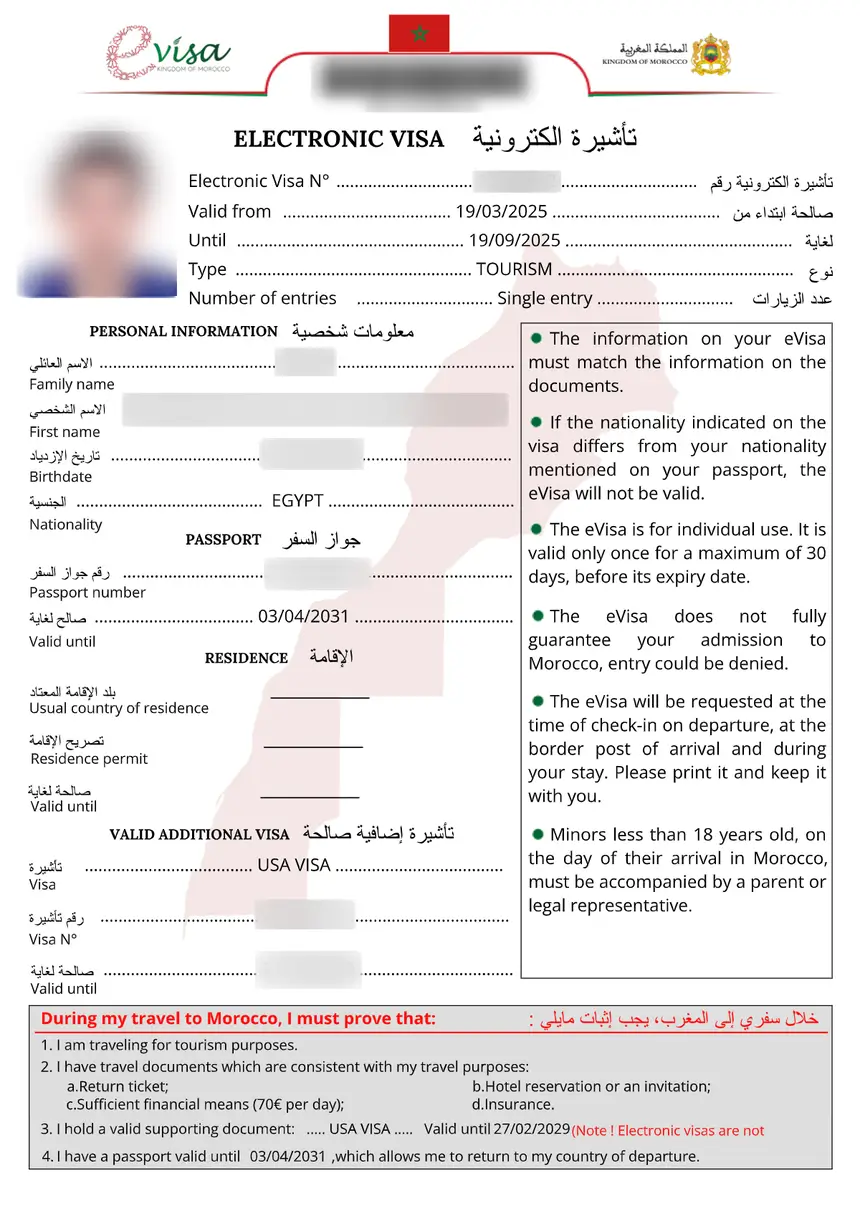
No – French citizens do not need to apply for a Morocco eVisa. The eVisa system, launched on July 10, 2022, was created for nationals of countries that require a visa to enter Morocco. Since France is on the visa-exempt list, French travelers bypass the eVisa entirely.
The Morocco eVisa is available through the official government portal at ma-visit.com and serves travelers from over 110 countries that are not visa-exempt.
| Feature | eVisa | Visa-Free (French Citizens) |
|---|---|---|
| Required for French citizens | No | N/A |
| Validity | 30 or 90 days | Up to 90 days |
| Application process | Online via ma-visit.com | None required |
| Cost | Varies by nationality | Free |
| Processing time | 24-72 hours | Instant (at border) |
The eVisa is relevant for citizens of countries like India, Pakistan, Nigeria, China, and many others. French citizens, along with other EU, UK, US, Canadian, Australian, and Japanese passport holders, do not need the eVisa.
However, French citizens who hold a valid residence permit or Schengen visa can help eligible third-country nationals apply for a Morocco eVisa. If you have family members or associates from visa-required countries traveling with you, they may qualify for an eVisa if they hold a valid French residence permit. Learn more in our Morocco eVisa guide.
Note: Morocco is developing an Electronic Travel Authorization (AEVM) system that may eventually require visa-exempt travelers to register before arrival. As of 2026, the AEVM applies only to select nationalities (Republic of the Congo, Ecuador, Ghana, Guinea) and does not apply to French citizens. Monitor official Moroccan government announcements for any changes.
Traveling from France to Morocco
France and Morocco are well connected by air and sea, with multiple daily direct flights and ferry routes available year-round.
Direct Flights
Multiple airlines operate direct flights from French cities to Moroccan destinations:
| Departure City | Destination | Flight Time | Airlines |
|---|---|---|---|
| Paris (CDG/ORY) | Casablanca (CMN) | 3h 15min | Royal Air Maroc, Air France, Transavia |
| Paris (CDG/ORY) | Marrakesh (RAK) | 3h 30min | Transavia, easyJet, Ryanair |
| Paris (CDG/ORY) | Agadir (AGA) | 3h 45min | Transavia, Royal Air Maroc |
| Lyon (LYS) | Marrakesh (RAK) | 3h 15min | Transavia, easyJet |
| Marseille (MRS) | Casablanca (CMN) | 2h 45min | Royal Air Maroc |
| Nice (NCE) | Marrakesh (RAK) | 3h | Transavia |
| Toulouse (TLS) | Marrakesh (RAK) | 2h 45min | Ryanair, Transavia |
| Bordeaux (BOD) | Marrakesh (RAK) | 3h | Transavia, Ryanair |
Flight times are short – typically 2.5 to 3.5 hours – making Morocco an ideal weekend or short-break destination from France. Budget airlines like Transavia, easyJet, and Ryanair offer competitive fares, especially during off-peak seasons.
Ferry Routes
For travelers who prefer to drive or bring a vehicle, ferry services connect southern France and Spain to Moroccan ports:
- Algeciras (Spain) to Tangier Med – the most popular route, approximately 1.5 hours
- Sete (France) to Tangier Med – direct ferry from southern France, approximately 36 hours
- Barcelona to Tangier Med – approximately 26 hours
The Algeciras-Tangier route is the busiest, with ferries departing every 30 minutes during peak times. Many French travelers drive through Spain and take the short crossing to Morocco.
Customs and Money Rules
Morocco has strict rules about what you can bring into the country and how much cash you can carry.
Moroccan Dirham (MAD)
The Moroccan dirham is a non-convertible currency, meaning you cannot exchange it outside Morocco. You must exchange your euros or other currency once you arrive. Exchange bureaus are available at airports, hotels, and in city centers.
Cash limits for entering Morocco:
- Moroccan dirhams: up to 2,000 MAD (approximately 185 EUR)
- Foreign currency: no limit, but amounts exceeding 100,000 MAD (approximately 9,300 EUR / 10,000 USD) must be declared at customs
ATMs are widely available in Moroccan cities and accept French bank cards. Visa and Mastercard are widely accepted in hotels, restaurants, and larger shops. Smaller vendors and souks typically prefer cash.
Prohibited and Restricted Items
Morocco prohibits or restricts the import of certain items:
- Drugs – zero tolerance, severe penalties
- Pornographic material – prohibited
- Religious materials – may be restricted if deemed proselytizing
- Alcohol – limited to 1 bottle of spirits and 2 bottles of wine
- Tobacco – limited to 200 cigarettes or 50 cigars
For full customs details, consult the Moroccan customs authority (in French).
Extending Your Stay Beyond 90 Days
If you want to stay in Morocco longer than the 90-day visa-free limit, you must apply for an extension before your current period expires.
How to Apply for an Extension
- Visit the local police station (commissariat) in the city where you are staying
- Bring your passport, proof of accommodation, and proof of sufficient funds
- Submit your request before the 90-day deadline
- Extensions are granted at the discretion of Moroccan authorities
Important Notes on Extensions
- Extensions are not guaranteed – approval depends on your circumstances
- Overstaying without an extension results in fines, detention, and potential deportation
- A formal deportation order may include a re-entry ban to Morocco
- The extension process can take several weeks, so apply early
For stays longer than 90 days for work, study, or residency purposes, you must apply for the appropriate long-term visa at a Moroccan embassy or consulate in France before traveling. See our guide to Morocco visa requirements for details on consular visa types.
Special Considerations for French Citizens
French-Moroccan Dual Nationals
Morocco does not recognize dual nationality in the same way France does. If you hold both French and Moroccan citizenship, Moroccan authorities consider you Moroccan first when you are on Moroccan soil. This means:
- You must enter and exit Morocco using your Moroccan passport
- French consular assistance may be limited while you are in Morocco
- Moroccan military service obligations may apply
- Exit from Morocco may be restricted if you have outstanding legal matters
If you are a dual national, consult both the French and Moroccan consulates before traveling.
Language Advantage
French is widely spoken in Morocco, making it one of the easiest destinations for French travelers. While Arabic and Berber (Tamazight) are the official languages, French is used extensively in:
- Government and business communications
- Education and universities
- Road signs and public notices in major cities
- Hotels, restaurants, and tourist services
- Banking and healthcare
This linguistic proximity means French travelers rarely face language barriers, unlike visitors from many other countries.
Strong France-Morocco Relations
France is Morocco’s largest European trading partner and one of its closest diplomatic allies. The relationship is supported by:
- Over 1.5 million people of Moroccan descent living in France
- Extensive trade, investment, and cultural exchange
- Direct flight connections from over 10 French cities
- Multiple French schools, cultural centers, and business networks in Morocco
This deep connection means French travelers benefit from well-established tourism infrastructure and a welcoming environment.
Frequently Asked Questions
Do French citizens need a visa for Morocco in 2026?
No. French citizens do not need a visa to visit Morocco for stays of up to 90 days. France has been on Morocco’s visa-exempt list since 1957. A valid French passport with at least 3 months of remaining validity is sufficient for entry.
Can I visit Morocco with an EU residence permit?
It depends on your nationality. If you are a French citizen, you do not need any additional documents beyond your French passport. If you are a non-EU citizen holding a French residence permit, you may qualify for a Morocco eVisa. The residence permit must be valid for at least 180 days from the date of application.
Can I get a visa on arrival in Morocco?
No. Morocco does not offer visa-on-arrival services. If you need a visa, you must either apply for an eVisa online or obtain a consular visa from a Moroccan embassy before traveling. French citizens do not need either, as they are visa-exempt.
How much is a Morocco visa in euros?
French citizens do not need to pay for a visa since they are visa-exempt. For reference, the Morocco eVisa (for visa-required nationalities) costs approximately 27-80 EUR depending on the type and processing speed. Consular visas cost approximately 20-30 EUR (single entry) or 30-45 EUR (double entry).
Can Moroccans go to France visa free?
No. Moroccan citizens need a Schengen visa to visit France. The Schengen visa application must be submitted at the French consulate or visa application center in Morocco. Processing typically takes 15 calendar days.
What happens if I overstay my 90 days in Morocco?
Overstaying the 90-day limit can result in fines, detention, and a formal deportation order that may include a re-entry ban. If you need to stay longer, apply for an extension at a local police station before the 90-day deadline.
Do I need travel insurance for Morocco?
Travel insurance is not a legal requirement for entry, but it is strongly recommended. Medical care in Morocco varies in quality, and evacuation to France for serious medical issues can be expensive. Your European Health Insurance Card (EHIC) is not valid in Morocco.
Is Morocco safe for French tourists?
Morocco is generally considered safe for tourists, including French visitors. However, standard travel precautions apply: avoid displaying expensive jewelry or electronics, be cautious in crowded areas, and use registered taxis or ride-sharing apps. The French government’s travel advisory for Morocco is typically at the lowest risk level.
Can I drive in Morocco with my French license?
Yes. French driving licenses are accepted in Morocco for tourist stays. If you plan to drive, carry your French license, vehicle registration documents, and proof of insurance. An International Driving Permit (IDP) is recommended but not strictly required for French license holders.
Should I get my passport stamped when entering Morocco?
Yes, absolutely. Make sure the border officer stamps your passport with an entry date. Some travelers have had difficulties leaving Morocco because their passport had no entry stamp. Without a stamp, Moroccan authorities cannot verify when you entered, which may result in questions about overstaying.