Morocco does not offer a visa on arrival. If your nationality requires a visa, you must obtain one before traveling through the eVisa system online or at a Moroccan embassy. However, citizens of over 65 countries can visit Morocco visa-free for up to 90 days, making visa on arrival unnecessary for most travelers. This guide compares all available entry options so you can choose the right one.
Does Morocco Have Visa on Arrival?
No. Morocco does not issue visas on arrival at any airport, seaport, or land border. This policy has been in place for decades and applies uniformly to all ports of entry, including Casablanca Mohammed V International Airport (CMN), Marrakech Menara Airport (RAK), and Tangier Med seaport.
If you arrive without a valid visa and your nationality is not on the visa-exempt list, immigration officers will deny entry and place you on the next available return flight at your own expense. There is no visa desk, no emergency counter, and no option to purchase a visa upon landing.
Unlike some destinations in Africa and the Middle East that offer visa on arrival as a convenience, Morocco requires all visa-required travelers to secure authorization before departure.
Morocco Entry Options at a Glance
Morocco offers three pathways for foreign nationals to enter the country, depending on nationality and purpose of travel:
| Entry Option | Who It Is For | How to Get It | Processing Time |
|---|---|---|---|
| Visa-free entry | Citizens of 65+ countries | No application needed | Instant at border |
| eVisa | 10 eligible countries + conditional applicants | Online via acces-maroc.ma | 24-72 hours |
| Embassy visa | All other nationalities | In-person at Moroccan consulate | 5-15 working days |
The eVisa is the closest alternative to a visa on arrival because it is obtained entirely online before travel. It replaced the need for in-person embassy visits for eligible nationalities when it launched on July 10, 2022.
Visa-Free Entry: No Visa Needed at All
Citizens of more than 65 countries can enter Morocco without any visa or prior authorization. If you hold a passport from one of these nations, you simply arrive with a valid passport and receive an entry stamp.
Key visa-exempt nationalities include:
- United States, Canada, Mexico, Brazil, Argentina
- All 27 EU member states, United Kingdom, Switzerland, Norway
- Japan, South Korea, Australia, New Zealand, Singapore
- Turkey, UAE, Saudi Arabia, Qatar, Kuwait, Bahrain, Oman
- Tunisia, Senegal, Mali, Niger, Gabon, Burkina Faso
Requirements for visa-free entry:
- Passport valid for at least 6 months from your entry date (GOV.UK advises 3 months minimum for UK citizens)
- Proof of return or onward travel
- Sufficient funds for your stay
- One blank passport page for the entry stamp
Visa-free stays are limited to 90 days. Overstaying can result in fines, detention, and future entry bans. Extensions beyond 90 days are not available for visa-free visitors; you must leave and re-enter or apply for a residence permit.
For the complete list of visa-exempt countries, see our Morocco visa-free countries guide.
Morocco eVisa: The Online Alternative
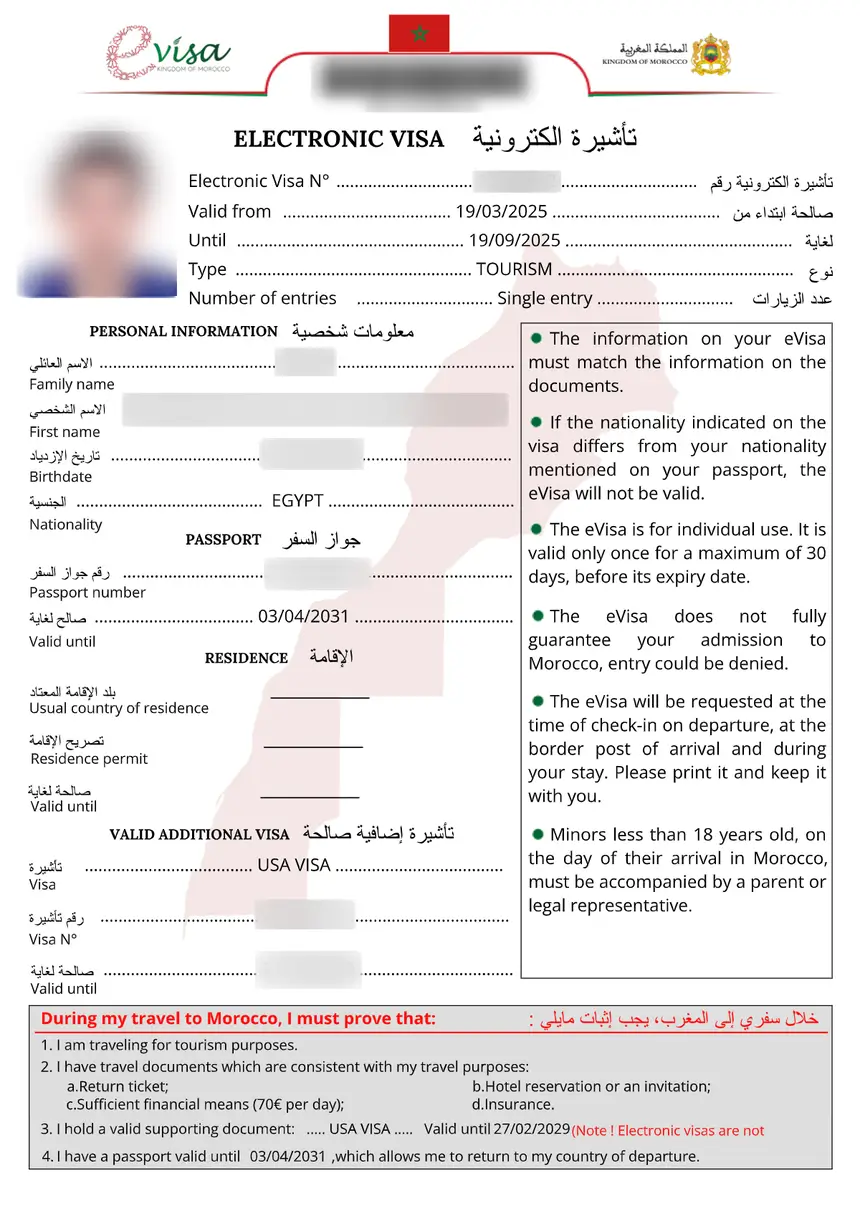
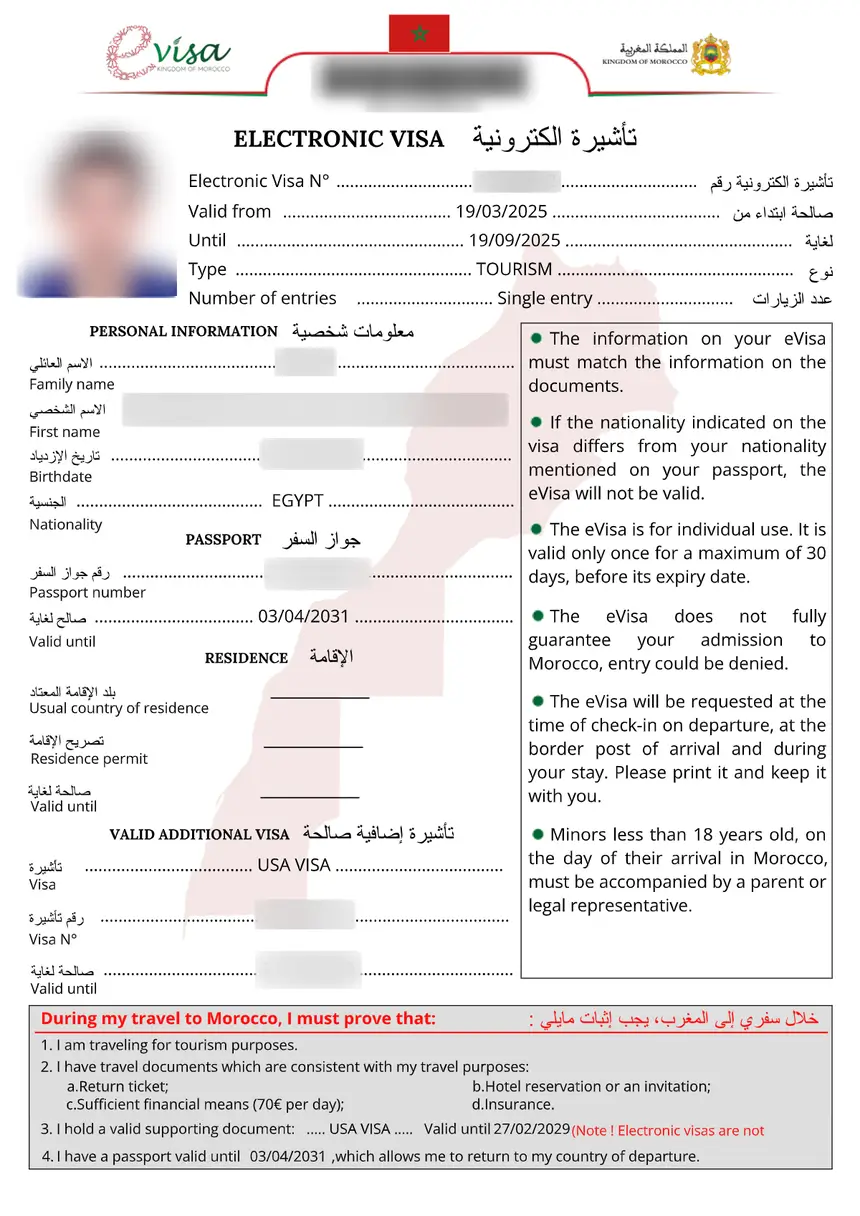
Since Morocco does not offer visa on arrival, the eVisa is the primary online option for travelers who need authorization before entering. Launched on July 10, 2022, the Morocco eVisa allows eligible nationals to apply entirely online without visiting an embassy or consulate.
Who Can Apply for the eVisa?
The eVisa is available in two categories:
Category 1 – Regular eVisa (no supporting documents required):
Citizens of 10 countries can apply with only their passport and a digital photograph:
- Benin, Brunei Darussalam, Cambodia, Guatemala
- India, Israel, Jordan, Laos
- Thailand, Vietnam
Category 2 – Conditional eVisa (qualifying visa required):
Citizens of most other visa-required countries can apply for an eVisa if they hold a valid, physically stamped visa or residence permit from:
- Any Schengen Area country
- United States, United Kingdom, Canada
- Australia, Ireland, Japan, New Zealand
For example, a Pakistani passport holder with a valid US visa can apply for the Morocco eVisa online. This conditional pathway opens the door for millions of travelers who would otherwise need a consular visa.
Countries that cannot apply for any eVisa: Iran, Kosovo, Palestine, Syria, Taiwan, and Tuvalu. Citizens of these nations must apply through a Moroccan embassy, and some require additional approval from the Moroccan Ministry of Interior.
eVisa Details
| Detail | Information |
|---|---|
| Validity | 180 days from date of issuance |
| Maximum stay | 30 days per visit |
| Entry type | Single entry |
| Extension | Extendable up to 180 days total in-country |
| Processing time | Standard: 3-6 working days; Rush: 2-4 days; Super Rush: 1-2 days |
| Fee | Approximately MAD 220 (~$22) via official portal |
| Official portal | acces-maroc.ma |
The eVisa must be downloaded and printed (or saved digitally) before travel. Present it alongside your passport at the immigration checkpoint upon arrival.
For step-by-step application instructions, see our how to apply for Morocco visa guide.
Embassy Visa: The Traditional Route
If you are not eligible for visa-free entry or the eVisa, you must apply through a Moroccan embassy or consulate in your country. This is the only option for citizens of nations excluded from both visa-free and eVisa pathways.
Embassy visa fees:
| Visa Type | Fee (MAD) | Approximate USD |
|---|---|---|
| Single-entry tourist | 220 | ~$23 |
| Double-entry | 330 | ~$34 |
| Transit visa | 170 | ~$18 |
Embassy visa processing: Typically 5-15 working days, depending on the consulate and your nationality. Some nationalities (Afghanistan, Iran, Iraq, Pakistan, Libya, North Korea, Syria) require additional approval from the Moroccan Ministry of Interior, which can extend processing times.
Required documents for embassy application:
- Completed visa application form
- Valid passport with at least 6 months validity
- Two passport photographs (35mm x 45mm)
- Proof of accommodation in Morocco
- Return flight reservation
- Proof of financial means
- Travel medical insurance
- Visa fee payment
For full document requirements, see our Morocco visa requirements page.
eVisa vs Visa on Arrival: Side-by-Side Comparison
Since Morocco does not offer visa on arrival, here is how the eVisa compares to what a theoretical visa on arrival would look like, based on common VOA programs in other countries:
| Feature | Morocco eVisa | Typical Visa on Arrival |
|---|---|---|
| Application method | Online before travel | At airport upon landing |
| Advance planning needed | Yes (apply 1-2 weeks before) | No (arrive and apply) |
| Approval guaranteed before travel | Yes | No (could be denied at border) |
| Processing time | 24-72 hours (standard 3-6 days) | 15-60 minutes at airport |
| Fee | ~$22 via official portal | Varies by country |
| Document uploads | Yes (passport scan, photo) | Usually minimal |
| Stay duration | 30 days | Varies (typically 14-30 days) |
| Extension possible | Yes, up to 180 days | Usually not |
The eVisa requires more advance planning than a visa on arrival, but it offers the certainty of approval before you book flights. You know you are authorized to enter Morocco before you leave home.
AEVM: Morocco Electronic Travel Authorization
In addition to the eVisa, Morocco offers an Electronic Travel Authorization called AEVM (Autorisation Electronique de Voyage au Maroc) for specific nationalities. As of 2026, the AEVM applies to citizens of:
- Republic of Congo
- Ecuador
- Guinea
- Ghana
The AEVM is not a visa on arrival. It is an electronic authorization that must be approved online before departure, similar to the US ESTA or Canada eTA. It functions as a separate entry category from the standard eVisa.
The AEVM may expand to additional nationalities in the future, potentially including other visa-exempt countries. This is worth monitoring if your nationality currently enters visa-free.
What Happens If You Arrive Without a Visa?
If your nationality requires a visa and you arrive at a Moroccan port of entry without one, the consequences are immediate:
- You will be denied entry by immigration officers
- You will be held at the airport in a transit area
- You will be placed on the next available return flight at your own expense
- The incident may be recorded and affect future visa applications
There is no grace period, no option to apply at the airport, and no emergency visa issuance. Morocco enforces this policy strictly at all entry points.
Common mistakes that lead to denial:
- Assuming Morocco offers visa on arrival because other North African countries do
- Believing an expired visa or eVisa is still valid
- Not checking visa requirements before booking flights
- Arriving with a damaged passport
Always verify your visa requirements well before booking travel. If you need a visa, apply for the eVisa at least two weeks before departure to allow time for processing.
Which Option Is Right for You?
Use this decision framework to determine your entry pathway:
Step 1: Check if your nationality is on the visa-free list. If yes, you need no visa for stays up to 90 days.
Step 2: If not visa-exempt, check if your country is on the eVisa eligible list. If yes, apply online at acces-maroc.ma.
Step 3: If not directly eligible for eVisa, check if you hold a valid Schengen, US, UK, Canadian, Australian, Irish, Japanese, or New Zealand visa or residence permit. If yes, you qualify for the conditional eVisa.
Step 4: If none of the above apply, you must apply at a Moroccan embassy or consulate.
For more details on visa types available for Morocco, see our Morocco visa types overview.
Frequently Asked Questions
Does Morocco offer visa on arrival?
No, Morocco does not offer visa on arrival at any airport, seaport, or land border. All visa-required travelers must obtain their visa before departure through the eVisa system online or by applying at a Moroccan embassy or consulate.
What is the difference between Morocco eVisa and visa on arrival?
The Morocco eVisa is applied for and approved online before travel, while a visa on arrival would be obtained at the airport after landing. Morocco only offers the eVisa option – there is no visa on arrival. The eVisa requires advance planning but guarantees approval before you fly.
Can US citizens get a visa on arrival in Morocco?
US citizens do not need any visa for Morocco. Americans can enter visa-free for stays of up to 90 days with a valid US passport. No eVisa or visa on arrival is needed.
Can Indian citizens get a visa on arrival in Morocco?
No, Indian citizens cannot get a visa on arrival. Indian passport holders must apply for the eVisa online through acces-maroc.ma. If you hold a valid US, UK, Schengen, Canadian, Australian, or Irish visa, you qualify for the conditional eVisa.
Can Pakistani citizens get a visa on arrival in Morocco?
No, Pakistani nationals cannot get a visa on arrival in Morocco. Pakistan requires additional approval from the Moroccan Ministry of Interior. Pakistani citizens must apply at a Moroccan embassy, or if they hold a qualifying visa (Schengen, US, UK, etc.), they may apply for the conditional eVisa online.
How much does the Morocco eVisa cost?
The Morocco eVisa costs approximately MAD 220 (~$22) through the official portal at acces-maroc.ma. Third-party service providers may charge additional processing fees ranging from $50 to $70. Always use the official portal to avoid unnecessary charges.
How long does the Morocco eVisa take to process?
Standard eVisa processing takes 3-6 working days. Rush processing takes 2-4 working days, and super rush processing takes 1-2 working days. Processing begins after payment confirmation. Apply at least two weeks before your travel date to allow for any unexpected delays.
Can I extend my stay in Morocco beyond 30 days on an eVisa?
Yes, eVisa holders can extend their stay beyond the initial 30 days by visiting a local immigration office (Bureau des Etrangers) in Morocco before the authorized stay expires. The eVisa can be extended up to 180 days total in-country.
Is there any way to get a visa at the airport in Morocco?
No. Morocco strictly requires all visa-required travelers to obtain their visa before arrival. There is no visa counter, no visa-on-arrival desk, and no emergency visa issuance at any Moroccan airport or port. The only exception is for visa-exempt nationalities who do not need any visa at all.
Which countries in North Africa offer visa on arrival?
Among Morocco’s neighbors, Tunisia offers visa on arrival for some nationalities, and Mauritania offers visa on arrival at Nouakchott airport. Algeria does not offer visa on arrival or eVisa. Morocco itself offers neither – it uses visa-free entry and eVisa instead.
What is the AEVM for Morocco?
The AEVM (Autorisation Electronique de Voyage au Maroc) is an electronic travel authorization for citizens of Republic of Congo, Ecuador, Guinea, and Ghana. It is not a visa on arrival – it must be approved online before departure. The AEVM may expand to additional nationalities in the future.
Morocco eVisa vs Visa on Arrival: Summary
Morocco does not offer visa on arrival, but it provides three clear entry pathways:
- Visa-free entry for 65+ countries (up to 90 days, no application needed)
- eVisa for eligible nationalities (online application, 30-day stay, ~$22)
- Embassy visa for all other nationalities (in-person application, 5-15 days processing)
The eVisa, launched in July 2022, is the closest alternative to visa on arrival and is available to citizens of 10 countries plus anyone holding a valid Schengen, US, UK, Canadian, Australian, Irish, Japanese, or New Zealand visa. For the fastest option, apply through the official portal at acces-maroc.ma.
For comprehensive information on all Morocco visa options, visit our Morocco eVisa complete guide or check the Morocco visa fees breakdown.