Morocco student visa is required for foreign nationals enrolling in study programs lasting more than 90 days. The process involves obtaining a visa from a Moroccan embassy or consulate before arrival, then applying for a student residence permit (Carte de Sejour) within 90 days of entering Morocco. Citizens of visa-exempt countries (including the US, UK, and EU nations) can enter without a visa for short courses under 90 days, but still need a residence permit for longer programs.
Who Needs a Morocco Student Visa?
Whether you need a student visa depends on your nationality and the length of your study program.
| Situation | Visa Needed? | Residence Permit Needed? |
|---|---|---|
| Visa-exempt nationality, program under 90 days | No | No |
| Visa-exempt nationality, program over 90 days | No (enter visa-free) | Yes |
| Visa-required nationality, any program | Yes | Yes (if over 90 days) |
Citizens of 65+ countries including the United States, United Kingdom, Canada, Australia, and most EU nations can enter Morocco without a visa for stays up to 90 days. However, if your academic program exceeds 90 days, you must obtain a student residence permit after arrival regardless of your nationality.
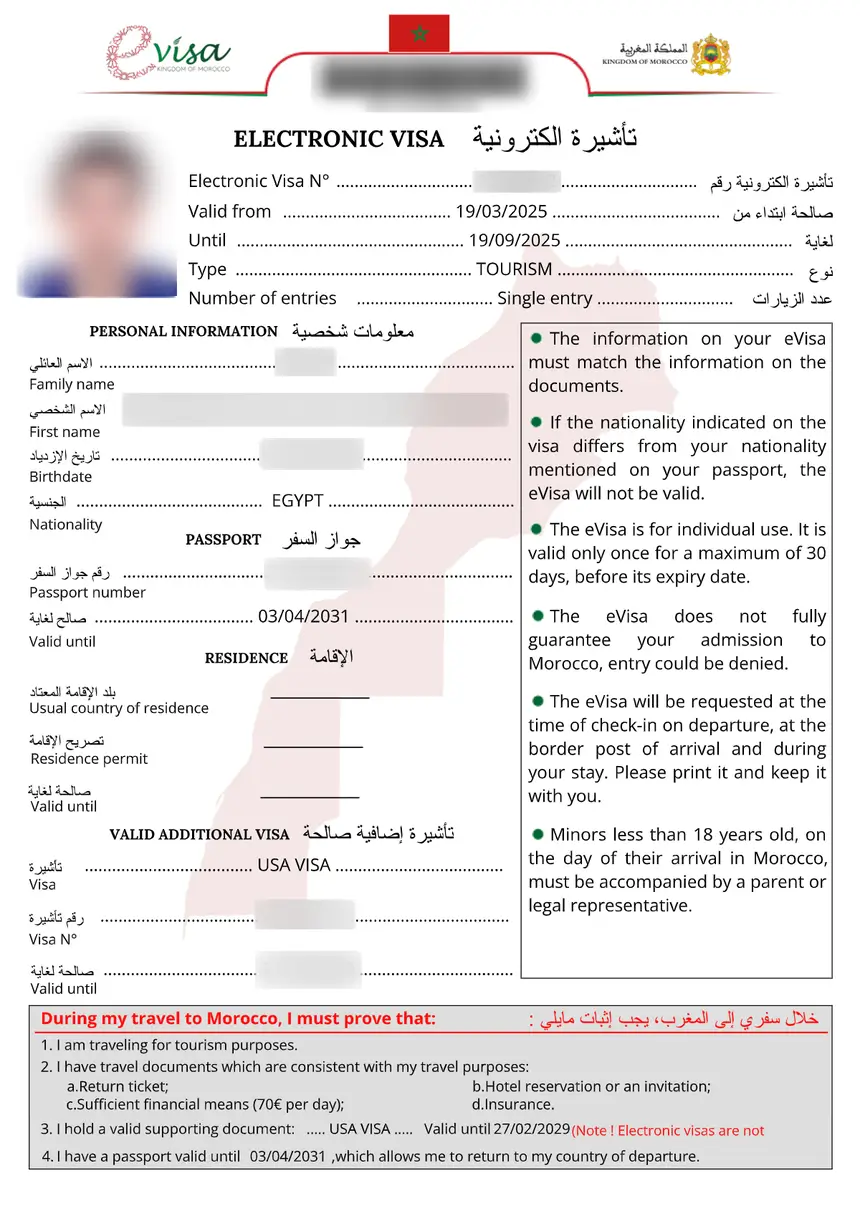
A tourist visa or eVisa cannot substitute for a student visa. If your nationality requires a visa and you plan to study, you must apply specifically for a student or long-stay visa through the embassy.
For a complete overview of visa-exempt nationalities, see our Morocco visa-free countries guide.
Types of Morocco Student Visa
Morocco offers two categories of student entry, depending on the duration of your program.
Short-Term Study Entry (Up to 90 Days)
This applies to students attending:
- Language courses
- Exchange programs under 3 months
- Short academic certificates or summer programs
Students from visa-exempt countries simply enter Morocco with a valid passport. Those from visa-required countries need a short-stay visa. This entry type does not lead to long-term residency and cannot be extended into a residence permit.
Long-Term Student Visa (More Than 90 Days)
This is the standard pathway for students enrolling in:
- Bachelor’s, Master’s, or PhD programs
- Year-long exchange programs
- Long-term research or training positions
The long-term student visa is typically issued as a single-entry permit valid for 90 days. During this period, the student must complete the residence permit application process inside Morocco. The visa itself is not renewable – instead, you transition to a student residence permit.
For general visa category information, visit our Morocco visa types page.
Documents Required for Morocco Student Visa
Gathering the correct documents is the most critical part of the application. Requirements vary slightly by consulate, but the standard set includes:
Admission and Academic Documents
- Admission letter or enrollment certificate from a recognized Moroccan educational institution
- Relevant diplomas and transcripts from previous education
- Translations and legalization of academic documents (if required by the consulate)
Financial Proof
- Bank statements showing sufficient funds to cover tuition and living expenses
- Sponsor or family financial documents if someone else is funding your studies
- Scholarship letter (if applicable, e.g., AMCI scholarship)
Travel and Identity Documents
- Valid passport with at least 6 months validity and at least one blank page
- Four recent passport-sized photographs
- Completed visa application form (available at the consulate or downloadable from consulat.ma)
- Travel insurance covering the duration of your stay
- Flight itinerary (arriving and departing)
Accommodation Proof
- University dormitory confirmation
- Rental contract in Morocco
- Host invitation letter (if staying with someone)
Additional Documents (Commonly Requested)
- Police clearance certificate from your country of residence
- Medical certificate (some consulates require this)
Check our Morocco visa requirements guide for general document requirements that apply to all visa types.
How to Apply for a Morocco Student Visa
The application process has two phases: obtaining the visa before travel, and securing the residence permit after arrival.
Phase 1: Applying for the Student Visa (Before Arrival)
Step 1: Secure university admission. Receive a formal acceptance letter (Confirmation of Acceptance for Studies) from your Moroccan institution and pay any enrollment fees.
Step 2: Schedule a consulate appointment. Contact your nearest Moroccan embassy or consulate. You can find the list of Moroccan embassies worldwide. Book your appointment well in advance – processing times vary by location.
Step 3: Complete the application form. Fill out the visa application form accurately. Forms are available at the consulate or can be downloaded from consulat.ma.
Step 4: Prepare your document package. Compile all required documents as listed above. Make copies of everything.
Step 5: Attend your appointment. Submit your documents in person and pay the application fee. Some consulates accept cash only.
Step 6: Await processing. Standard processing takes approximately 10 business days, though it can take longer during peak periods (August-September for fall enrollment). Some consulates offer expedited processing for an additional fee.
Step 7: Receive your visa. If approved, you will receive a student visa sticker in your passport, valid for entry to Morocco.
Phase 2: Applying for the Residence Permit (After Arrival)
Once in Morocco, you must apply for a student residence permit within 90 days of entry. This is done at the local Bureau des Etrangers (Foreign Nationals Office), part of the Police Prefecture (Surete Nationale).
Step 1: Register with the police. Visit your nearest Bureau des Etrangers to begin the residence permit process.
Step 2: Complete the application forms. You will receive forms called “formulaires a prendre aupres service sejour” at the office.
Step 3: Submit supporting documents including:
- Passport with student visa
- Two copies of your passport pages
- Updated university enrollment certificate
- Proof of Moroccan address (rental contract or dorm confirmation)
- Proof of financial means
- Three to four passport-sized photographs
- Medical certificate (if required)
- Applicable fees
Step 4: Pay the residence permit fee. The service fee is approximately 200 MAD (~$20).
Step 5: Receive a temporary receipt (Recepisse). This document serves as your interim residence permit while the official card is being processed.
Step 6: Collect your residence permit. Your official student residence permit (Carte de Sejour – Student) is typically ready within 1 to 3 months. It is valid for 1 year and is renewable annually for the duration of your studies.
For step-by-step guidance on the general application process, see our how to apply for Morocco visa guide.
Morocco Student Visa Fees
Student visa costs in Morocco are relatively affordable compared to many other study destinations.
| Fee Type | Cost (MAD) | Cost (USD) |
|---|---|---|
| Single-entry student visa | 220 | ~$23 |
| Residence permit (annual) | 200 | ~$20 |
| University application fee | 800 | ~$80 |
| Total estimated first-year costs | 1,220 | ~$123 |
Fees may vary depending on your nationality and the specific consulate. Some nationalities pay higher visa fees due to reciprocal agreements. For a complete breakdown of all Morocco visa fees, visit our Morocco visa fees page.
Morocco Student Visa Processing Time
| Stage | Typical Duration |
|---|---|
| Visa application processing | 10 business days |
| Residence permit processing | 1 to 3 months |
| Total visa-to-residence timeline | 6 to 14 weeks |
Apply at least 2 months before your program start date to account for processing delays. Peak season (July-September) may result in longer wait times at consulates.
For more details on processing timelines, see our Morocco visa processing time guide.
Scholarships and AMCI
The Moroccan International Cooperation Agency (AMCI) administers scholarships for foreign students annually as part of cooperation agreements between Morocco and partner countries. AMCI scholarships typically cover:
- Tuition fees
- Monthly stipend
- University housing
- Health insurance
Students arriving through AMCI must complete their application at the agency upon arrival and register at the nearest police station to obtain their residence permit. Morocco has approximately 25 university cities and boarding schools where AMCI students can be placed.
Can You Work While Studying in Morocco?
Student status does not automatically grant work rights. Any employment while on a student visa requires separate authorization from Moroccan authorities. Working without proper authorization can result in:
- Fine and penalties
- Cancellation of your student residence permit
- Deportation and re-entry ban
If you wish to work during your studies, you must apply for a separate work permit through the Moroccan labor authorities.
Can Your Family Join You in Morocco?
Family members (spouse, children) cannot automatically join a student visa holder. They would need to apply for their own visas independently. Morocco does not offer a specific “dependent visa” category for student visa holders. Family members may apply for:
- Tourist visa (for short visits up to 90 days)
- Their own long-stay visa if they have a separate qualifying reason
What If Your Student Visa Is Rejected?
Visa rejection is possible if:
- Documents are incomplete or inconsistent
- Financial proof is insufficient
- The educational institution is not recognized
- There are security or criminal record concerns
If rejected, you can:
- Request the reason for rejection from the consulate
- Address the specific issue and reapply
- Appeal the decision through the consulate’s appeals process
- Seek assistance from your university’s international student office
There is no mandatory waiting period before reapplying, but you should only resubmit once you have resolved the reason for the initial rejection.
Tips for a Successful Application
- Start early. Begin the process at least 3 months before your program starts
- Check specific consulate requirements. Document requirements vary slightly between Moroccan embassies in different countries
- Make extra copies. Bring at least 2-3 copies of every document
- Get documents legalized. Some consulates require apostille or legalization of academic documents
- Keep your receipt. The Recepisse (temporary receipt) is your legal proof of residence while the permit is being processed
- Renew on time. Apply for residence permit renewal at least 1 month before expiry to avoid overstaying penalties
FAQs About Morocco Student Visa
How much does a Morocco student visa cost?
A single-entry student visa costs approximately 220 MAD (~$23 USD). The annual residence permit adds 200 MAD (~$20 USD). University application fees are typically 800 MAD (~$80 USD). Total first-year costs are around 1,220 MAD (~$123 USD).
Can US citizens study in Morocco without a visa?
Yes, US citizens can enter Morocco without a visa and stay for up to 90 days. For study programs shorter than 90 days, no visa is needed. For longer programs, US students must apply for a student residence permit after arrival at the local Bureau des Etrangers.
How long does it take to get a Morocco student visa?
Visa processing typically takes about 10 business days at the consulate. After arrival, the residence permit takes 1 to 3 months to process. Plan for a total timeline of 6 to 14 weeks from application to receiving your residence card.
Can I work while studying in Morocco with a student visa?
No, student status does not automatically grant work rights in Morocco. You need a separate work permit authorized by Moroccan labor authorities. Working without authorization can lead to fines, permit cancellation, and deportation.
What is the Carte de Sejour for students?
The Carte de Sejour (Student) is the official student residence permit in Morocco. It is valid for 1 year, renewable annually, and allows you to legally reside in Morocco for the duration of your studies. You must apply within 90 days of arrival.
Do I need a student visa if I am from a visa-exempt country?
If your program is under 90 days, no visa or residence permit is needed. If your program exceeds 90 days, you enter visa-free but must apply for a student residence permit within 90 days of arrival.
What documents do I need for a Morocco student visa?
You need an admission letter from a Moroccan university, valid passport (6+ months validity), passport photos, proof of financial means, accommodation proof, travel insurance, completed application form, and often a police clearance certificate and medical certificate.
Can I extend my student visa in Morocco?
Student visas themselves cannot be extended. Instead, you must apply for a student residence permit (Carte de Sejour) which is valid for 1 year and renewable annually. This must be done before your visa expires.
What is AMCI and how can it help international students?
AMCI (Moroccan International Cooperation Agency) offers scholarships to foreign students through cooperation agreements with partner countries. Scholarships typically cover tuition, a monthly stipend, university housing, and health insurance. Applications go through your country’s education ministry.
Can my family members accompany me on a student visa?
Family members cannot automatically join you on a student visa. They must apply for their own visas independently. Morocco does not offer a specific dependent visa category for student visa holders.